





In October 2025, with Senate Republicans and Democrats unable to come to an agreement on the then-expiring Affordable Care Act (ACA) subsidies, the country plummeted into what later became the longest government shutdown in the history of the U.S. Just months later, we are on the cusp of another — this time partial — government shutdown as Democrats call for reforms to rein in ICE following the Saturday killing of Alex Pretti in the hands of federal agents in Minnesota.
This time, the dynamics around senators’ negotiations to avoid or, if it comes down to it, end the shutdown are strikingly different from the last time around.
For weeks prior to and during the 2025 shutdown, Senate Republican leadership refused to come to the table and negotiate with Democrats on extending the Affordable Care Act (ACA) subsidies.
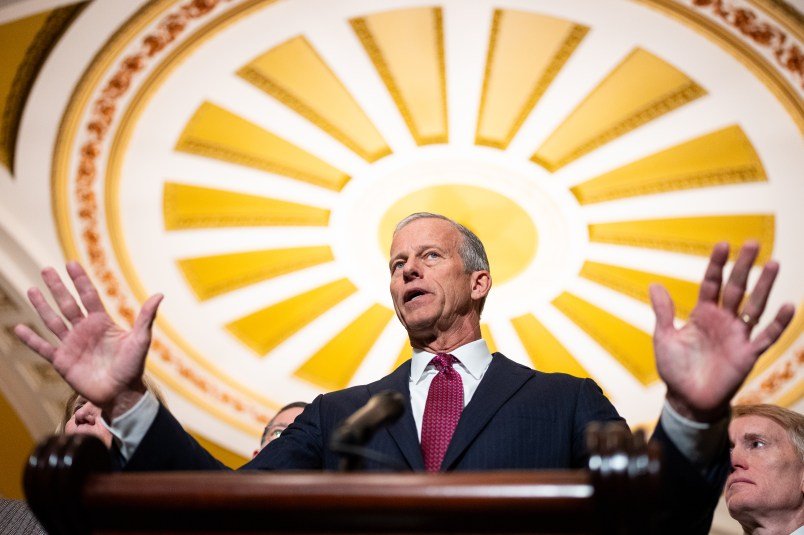
Senate Majority Leader John Thune (R-SD) over and over again said Republicans will not negotiate a policy issue as a part of the funding process and insisted that Democrats vote for the GOP continuing resolution (CR) and reopen the government to unlock health care negotiations.
This time, Republicans are negotiating with Democrats and encouraging Senate Democrats to negotiate directly with the White House.
“If they have things that they want, they should make them known,” Thune said of his Democratic colleagues before they laid out their list of priorities Wednesday afternoon.
“The White House obviously is open to negotiation,” he added — a striking shift from last October.
Senate appropriators were also encouraging Democrats to engage in conversations with the Trump White House.
“We think the Dems should be negotiating with the White House for an appropriate discussion,” Sen. Mike Rounds (R-SD), a member of the appropriations committee, said. “Once that occurs, I think we’re on board with trying to make sure that we don’t get into a shutdown situation.”
What changed?
It’s hard to ignore the visceral outrage felt by Americans in the wake of two killings involving federal agents, both of which were captured from numerous angles, and both of which were easily and extensively found on social media feeds, on television, and in newspapers. Polls suggest that, as we approach a possible shutdown, the reason for it is resonating differently than the more abstract policy issues — even ones of life and death, as health care may be — that the conversation focused on late last year.
“The power of the media, the power of TV, is the difference this time around,” Wendell Primus, who was the former senior policy advisor on health and budget issues to Speaker Nancy Pelosi (D-CA) for 18 years, told TPM.
“Anybody can see what’s going on in Minnesota … it’s not going to help if you’re in charge. If you’re the administration, it ain’t working,” Primus continued. “Trump watches a lot of TV … and I think TV makes the case very clearly, the situation has to change.”
On top of that, Primus — who was the lead House staffer in developing the Affordable Care Act — told TPM “Republicans have always had difficulties” with the ACA. And, he added, it “just doesn’t make for TV quite the way” as what is happening in Minnesota does.
It is certainly easier for Democrats to message around American citizens getting killed in the streets of Minneapolis at the hand of federal agents. And, on top of that, Democrats feel — and polls support — that the public is on their side as they push back on the practices ICE has been engaging in as a part of the Trump administration’s immigration enforcement spectacle, which has unfolded on and at times seemed engineered for social media over the past year.
New polling by the Searchlight Institute found that “large bipartisan majorities of voters oppose ICE’s lawless tactics, including detaining U.S. citizens (73%), entering people’s homes without warrants (79%), and failing to wear clearly identifying uniforms (70%).”
Some Democrats also think, with midterm elections right around the corner, Republicans don’t want to be stuck in a fight where they are defending federal agents killing American citizens on the streets.
“I don’t think Republicans want to be in a position of defending this abuse and illegality,” Sen. Chris Murphy (D-CT) told reporters, including TPM, during a Wednesday gaggle.
Hiding Behind Budget Procedure
The procedures around how Congress appropriates funds also make it harder for Republicans to avoid negotiating this time around.
Technically, Congressional Republican leaderships’ argument that the then-expiring Obamacare subsidies were not a part of the appropriations process was accurate. That argument is not available to them this time.
“The ACA subsidies are not part of the annual appropriations process but DHS and ICE are … So they can claim that those are directly related to the appropriations process,” Bobby Kogan, senior director of federal budget policy at the Center for American Progress, told TPM.
“That is, however, the generous interpretation,” he continued when asked about why he thinks this round of negotiations look different. “The less generous interpretation is that all fights are political, and Thune understands that. He understands he needs to make changes to the DHS but he didn’t want to extend the ACA subsidies because he was against it.”
Pushing back on the technical — or as Kogan calls it “generous” — interpretation, experts also pointed out to TPM that negotiations between the Senate Republicans and Democrats included an option where Democrats would vote to support the current DHS bill in exchange for separate legislation where their concerns about ICE conduct are addressed. A separate bill would, of course, be separate from the budget process as well — making their point from October mute.
Thune also said this week that he’s pushing for dialogue between the Trump administration and Senate Democrats so the two sides can reach “some mechanism whereby you don’t have to change the bill or split it out and have to send something back to the House.”
That is far from the attitude congressional Republican leadership took last time around when they claimed there was nothing for President Donald Trump to discuss with Democrats and that they needed to get onboard and simply help pass the GOP CR.
The Hypocrisy
Kogan also pointed to the GOP hypocrisy around the last shutdown, saying holding issues that are not directly related to the budget is a frequent practice congressional Republicans engage in.
“Republicans are frequently trying to do stuff that is not directly related to the appropriation process,” Kogan said. “There are tons and tons and tons and tons and tons of unrelated riders all the time on every appropriations bill and they have no problem with that.”
“They frequently use the leverage they have,” Kogan added. “For example, during every debt limit negotiation they try to do budget changes … and an equivalent, in 2013 they told Democrats ‘unless you end the ACA, we’ll shut down the government.’ And they shut down the government.”
Put simply, Kogan explained, they are okay with the same thing Democrats did when it’s about something they like.
“The real issue behind it all was that they didn’t want to extend the ACA subsidies,” Kogan said.