


This article is part of TPM’s ongoing “Creating the Enemy Within” project, tracking the Trump administration’s efforts to crack down on dissent.
As the Trump administration brings anti-Trump activists up on terrorism charges, it’s finding that one state has already cleared a path.
In Texas, state prosecutors are using a 2023 anti-terrorism law to investigate and charge what the Trump administration has deemed an “Antifa cell” in a parallel federal prosecution. The investigations center on events surrounding a July 2025 demonstration outside the Prairieland, Texas, ICE detention facility during which a responding police officer was shot. Trial is underway in the federal case, part of a wave of federal material support for terrorism charges filed against activists across the country.
Texas prosecutors have their own set of cases stemming from the incident, and have used the recently passed law, SB 1518, to charge people on the periphery of the Prairieland incident. Three people face hindering prosecution of terrorism charges, a crime created by the 2023 law, for allegedly advising or helping people leave digital chatrooms that were used to plan the demonstration. It’s the first known example, Texas attorneys told TPM, of state officials charging people under the 2023 anti-terrorism law.
The Texas cases illustrate how new state domestic terrorism statutes are beginning to intersect with the Trump administration’s push to frame anti-Trump activism as a counterterrorism problem. SB 1518 gives local prosecutors new offenses, like hindering the prosecution of terrorism, that can be used against people far removed from an alleged act of violence; the federal government is pursuing sweeping material-support for terrorism charges tied to the same protest. Together, the parallel cases offer an early test of how at least one state terrorism law passed in recent years can amplify a uniquely Trump-era crackdown, raising concerns among legal scholars and civil liberties advocates that tools designed to combat political violence are being extended to criminalize constitutionally protected political association.
Once these laws are on the books, they are rarely revised to be more narrowly targeted; it is mostly a one-way ratchet.
Elly Page, International Center for Nonprofit Law
The Texas law was passed amid a wave of other state domestic terrorism laws, a report by the International Center for Nonprofit Law found. In the wake of Gaza protests, the 2020 Black Lives Matter demonstrations, and January 6, state legislatures sought to provide local prosecutors with new tools that, experts argue, can blur the line between violent conduct and political association.
The state law’s usage in the sprawling Prairieland case has stoked concerns about the way in which the federal crackdown is being accompanied by the Texas state effort. The Prarieland case was charged federally as a terrorism matter after Trump directed Joint Terrorism Task Forces in NSPM-7 to prioritize anti-Trump activists in domestic terrorism investigations.
Elly Page, a senior legal adviser at ICNL who co-authored the report, told TPM by email that because the state laws “carry extremely steep criminal penalties and rely on an expansive definition of ‘terrorism,’ state actors can use them in a targeted way against protest movements and political activism they disagree with.”
The laws create new crimes, empowering some states to establish terrorist registries, charge people with terrorism, and slap them with stiffer sentences.
“Once these laws are on the books, they are rarely revised to be more narrowly targeted; it is mostly a one-way ratchet,” Page added.
Sandra Guerra Thompson, a criminal law professor at the University of Houston Law Center, said that SB 1518 was striking in part for its harshness: a charge of hindering the prosecution of terrorism, applied for the first time to people linked to the Prairieland incident, is punishable as severely as the underlying offense of terrorism.
“That’s crazy,” she remarked.
Terrorism offender registry
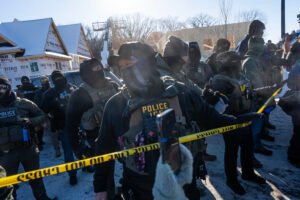
What started with a plan for what activists described as a “noise demonstration” on the evening of July 4 quickly got out of hand, defense attorneys and friends of those charged told TPM. By the end of the night, cars and walls had been graffitied, a surveillance camera had been damaged, and a responding police officer had been shot and wounded. Federal prosecutors have charged 16 people over the incident; many of them, along with three additional defendants, also face state charges. State and federal prosecutors accuse Ben Song, a former Marine reservist, of shooting the officer. Song has pleaded not guilty in both the federal and state cases.
At the federal level, prosecutors have used membership in large Signal chats, wearing black clothing, and loose ideological affiliations to tie activists at the demonstration to Song.
Beyond those who were there that day, state prosecutors have also brought charges under SB 1518 against activists who engaged in some way with the digital chat rooms in which the demonstrators allegedly coordinated.
SB 1518 defines terrorism as an effort to “influence, by intimidation or coercion, the policy, conduct, or activities of” the government. It was mostly passed to create a Texas terrorism registry, similar to a sex offender registry. The law tacked on new terrorism offenses as well.
The law is one of a wave of statutes passed across the country that have faced questions over whether their definition of terrorism is unconstitutionally vague. In Georgia, defense attorneys in a case charged under a similar statute mounted a free speech challenge to the law in federal court. A judge dismissed the case without ruling on the substance of the claim.
Leaving the chat
Dario Sanchez is one of three involved in the Prairieland incident who only face state charges. He faces one count of hindering the prosecution of terrorism under SB 1518 and one count of tampering with evidence.
A former middle school computer science teacher, Sanchez told TPM that he met the group of people who would later become defendants through the Dallas-Forth Worth chapter of the Socialist Rifle Association.
Sanchez told TPM that he saw a flyer advertising the July 4 demonstration in Signal chats but decided not to go. The next day, he saw that people were panicking about arrests but still did not think much of it.
At the same time, according to the Dallas U.S. Attorney’s Office, Ben Song was on the run. Federal law enforcement were trying to find him (Song wasn’t arrested until July 15).
On July 9, John Thomas, another local activist who lived with Song, came to Sanchez’s house “in a panic,” Sanchez recounted to TPM, because their apartment had been “raided by the FBI.”
“I figured, okay, well, this makes some sense because you’re roommates with Ben Song who was there and is apparently, like, on the run or something,” Sanchez recalled.
Thomas told Sanchez that the FBI had seized his devices, and that he no longer had access to his accounts, Sanchez recounted to TPM. He asked Sanchez to remove him from chats, Sanchez recalled.
Sanchez was the “sole moderator” of a Discord server for Texas Socialist Rifle Association chapters, he told TPM. He agreed to the request, removing Thomas.
Sanchez’s attorney told TPM that he wasn’t able to find other examples of the hindering the prosecution of terrorism charges, stemming from SB 1518, being applied before the case against his client.
An arrest warrant for Sanchez was issued on July 14. The next day, Sanchez recalled, he woke at dawn to a voice on a loudspeaker demanding that he exit his house with his hands up. A drone entered his living room, and he was arrested and questioned by an FBI official and a local Texas officer, he said.
Thomas later pleaded guilty in the federal case to one count of material support of terrorism. Thomas was not at the demonstration; he admitted to having helped conceal Song in a series of acts, between July 5 and July 7, that the plea agreement detailed. His attorney did not return TPM’s requests for comment.
Sanchez has pleaded not guilty. He told TPM that he is comfortable speaking about the allegations that led to his indictment because he believes he did nothing wrong.
“Removing somebody from a group chat of any kind doesn’t materially alter what’s in that chat,” Sanchez said. “I simply stopped somebody from accessing it since they could no longer do that via their devices.”
New questions
The case presents a question: is removing someone from a chat enough to qualify as tampering with evidence? And, in the case of Texas’ SB 1518, to qualify as hindering the prosecution of terrorism?
Sanchez’s lawyers have argued that the law only prohibits tampering with “physical” evidence, not digital, and that prosecutors have failed to define what act of “terrorism” was committed. They’ve also argued that removing someone from a chat prevents the person having the chance to tamper with it in the future.
“We just don’t think that Dario has anything to hide or should have anything to hide,” Dustin Hoffman, an attorney for Sanchez, told TPM.
To Thompson, the criminal law professor at the University of Houston Law Center, it’s less clear-cut. Though Texas’ hindering the prosecution of terrorism count is unclear in part because it has seemingly never been charged before, tampering cases usually come down to the defendant’s state of mind and whether they knew that the record they altered was relevant to an ongoing investigation, Thompson said.
“A lot of this is going to depend on accessibility to law enforcement and whether there was an intent to shield someone from something or to prevent the police from obtaining it,” she said.
In a parallel case arising from the Prairieland incident, state prosecutors charged Janette Goering with one count of hindering the prosecution of terrorism under SB 1518.
Goering wasn’t at the protest, her partner, Jesse Spahn, told TPM, but she went to the area outside the detention center the next day and, prosecutors said, met with others who later pleaded guilty in federal court to charges emanating from Song’s alleged attempt to evade arrest after the July 4 incident.
“She volunteered to go and see what was going on down there because at that point, most information was pretty sparse,” Spahn said.
State prosecutors alleged in a search warrant affidavit that Goering recommended that others leave a Signal chat after the demonstration, and that she provided faraday bags — a container used to prevent cellular transmission — before the demonstration.
Goering has pleaded not guilty.
The Johnson County DA’s Office, which is prosecuting Goering and Sanchez, didn’t return TPM’s request for comment.
To Meagan Knuth, the Dallas representative of the National Lawyers Guild, the state cases show that prosecutors are treating vague, shared ideology as a crime, largely by focusing on what she described as “basic admin tasks.”
The prosecutions have had a chilling effect on activism in the area, she said, in part because it’s created the impression that prosecutors are trying to “paint as criminal” tasks that, in the minds of the defendants, were associated with protest. It’s prompted people who earlier had been enthusiastic about protesting to stay home, she said.
“They’re afraid that they’re being watched by the government or they’re gonna be put on some list,” she said.