




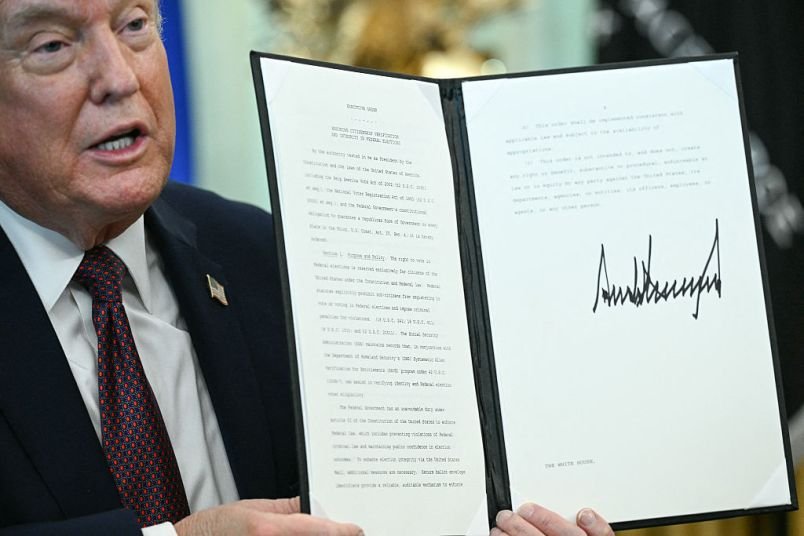
A U.S. district judge on Thursday blocked the crux of President Donald Trump’s March executive order, which ordered the creation of a federal citizen list and dictated to whom the Postal Service can send absentee ballots.
Judge Indira Talwani, an Obama appointee in Massachusetts, found that those components of the order exceed the president’s power and enjoined them for the plaintiff states. Those states are Arizona, California, Colorado, Connecticut, Delaware, Illinois, Maine, Maryland, Massachusetts, Michigan, Minnesota, Nevada, New Jersey, New Mexico, New York, North Carolina, Oregon, Rhode Island, Vermont, Virginia, Washington, Wisconsin, and Josh Shapiro in his official capacity as Governor of Pennsylvania.
A group of red states intervened on the Trump administration’s side.
The Trump administration argued that the blue and purple states don’t yet have standing to challenge the order, because it hasn’t yet been implemented. A Trump appointee in Washington D.C. agreed with that argument in a late May ruling.
Talwani was less amenable.
“Defendants and Intervenors are incorrect. Plaintiff States are actively working to conduct primary, special, and general elections,” she wrote. “The EO has ordered administrative agencies to take action in the coming months that has already required Plaintiff States to respond given the practical nature of an election cycle.”
Postmaster General David Steiner testified before the Senate Homeland Security Committee on Wednesday, saying that in accordance with its proposed rule, the Postal Service would not deliver absentee ballots to states that don’t hand over voter and citizenship information to be compiled into some kind of federal list.
“Congress, consistent with the Constitution, has left that authority to the States alone,” Talwani wrote. “Accordingly, the creation of the Confirmed Citizen Lists is ultra vires because the President lacks any authority to compile voter lists for each State.”
“The Constitution reserves the power to determine voter eligibility to the States alone,” she added. “Neither the Executive Branch nor Congress may interfere with this power.”
The executive order has been challenged in multiple federal courts and most of it has been blocked, at least for now.
Read the ruling here: