


The Broadview Six case didn’t happen in a void.
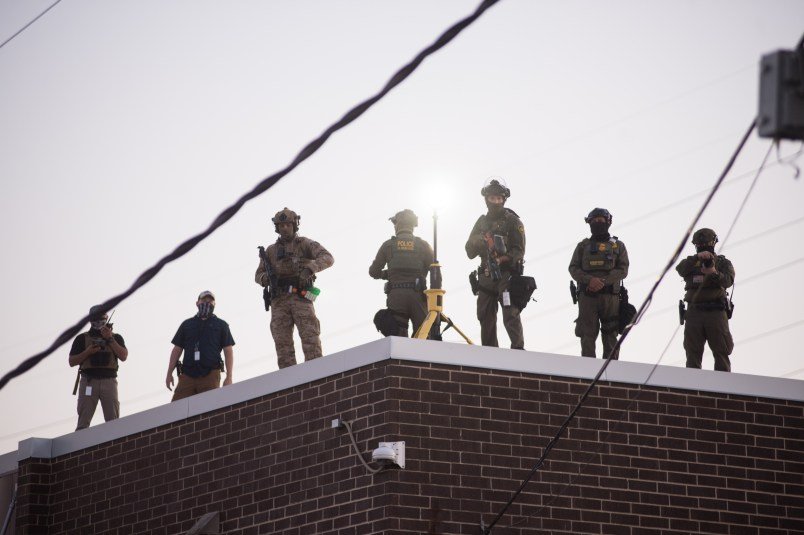
In the month that Chicago federal prosecutors returned three times to the same grand jury to try to secure an indictment of the same set of protesters, their office was under intense pressure. Greg Bovino had arrived in the city the month before, heralding a surge of federal officers under so-called “Operation Midway Blitz” that prompted mass protests. Trump-appointed DOJ leadership was demanding that prosecutors bring the most aggressive possible charges against those involved in anti-ICE demonstrations. At the same time, those cases kept collapsing: in some cases, grand juries made the rare move of refusing to return indictments. Judges were becoming increasingly skeptical of the government and federal prosecutors in particular as they brought aggressive charges that repeatedly failed in court against protestors caught up in the surge.
Now, more than half a year later, the Broadview Six case — one of the most high-profile of these prosecutions — has collapsed, yielding substantial new evidence of prosecutorial misconduct. U.S. Attorney Andrew Boutros has put out a statement explaining his role in the case, including a transcript of remarks — themselves highly unusual and according to experts improper — that he made encouraging grand jurors who had strong feelings about “a certain type of cases, such as the immigration cases” to raise their hand and “identify” themselves.
A TPM review of prosecutions during Operation Midway Blitz shows the pressure-cooker environment that gave rise to the blossoming scandal.
DHS announced that it would surge federal immigration enforcement into Chicago on September 8, using ICE, CBP, and officers detailed from other agencies. Eight days later, Bovino arrived in the city, announcing on social media that he was there to “continue the mission we started in Los Angeles.”
LA had been a debacle of national proportions, though it hadn’t broken through to the extent Chicago would. In California, Bovino had led a militarized campaign that had two parts. On one side, it was an extremely aggressive, scattershot approach at detaining undocumented immigrants. On the other, he used the same law enforcement might to detain anyone who got in the way. Per one estimate from ProPublica and Frontline, more than 100 U.S. citizens were charged in Southern California with interfering with federal law enforcement; in a preview of what would play out in Chicago, more than one third of those cases have since crumbled.
Bovino’s arrival in Illinois came with the same aggressive tactics, and the same focus on U.S. citizen protestors. Within days, mass protests erupted at the Broadview detention facility in the Chicago suburbs. On September 26, the “Broadview Six” participated in the protest that would lead to their later indictment.
Trump administration officials and aligned influencers were simultaneously pushing to stage the crackdown on their political opposition that they had long envisioned. On Sept. 10, right-wing organizer Charlie Kirk had been assassinated; in the weeks after, the White House directed federal law enforcement to focus on a broad range of activities and ideas it deemed anti-American. It declared “Antifa” a domestic terrorist organization, a category that does not exist under American law. It also issued NSPM-7, a national security memorandum directing the FBI and prosecutors to treat ideologies that oppose the administration as indicia of domestic terrorism and to scrutinize those who espouse “anti-Americanism, anti-capitalism, and anti-Christianity.” On September 29, then-Attorney General Pam Bondi issued a memo titled “Ending Political Violence Against ICE,” directing prosecutors to bring the most aggressive possible charges against anyone suspected of assaulting or obstructing law enforcement while citing the “Broadview Six” protest as an example of “political violence.”
In Chicago, federal prosecutors had begun to aggressively charge protestors across the city. They did so as their office began to hemorrhage members: on Sept. 24, days after Bovino arrived in the city, the chief of the U.S. attorney office’s criminal division said in a court filing that she was leaving the office. Boutros had earlier sent a mass email inviting people to join the office amid more departures.
The protestor cases quickly crumbled on contact with the judicial system.
Take the cases of Hubert Mazur and Cole Sheridan. Prosecutors first charged Mazur on September 28 with forcibly resisting a federal officer over a protest the day before at Broadview. The next month, on October 8, the government moved to dismiss the case after body-worn camera footage contradicted the charges.
Cole Sheridan was initially charged with felony assault of a federal officer over an Oct. 3 incident in which he allegedly damaged Bovino’s groin. But at an October 9 hearing, the case began to crumble as the judge was skeptical that the facts really supported the idea that Sheridan assaulted Bovino.
“The government’s position is … that Mr. Sheridan is alleged to have pushed on Chief Bovino, that that push alone is what? Forcible what? Forcible assault?” the judge asked.
William Hogan, a prosecutor, replied, “Forcible interference at the very least,” before conceding, “I am not saying that he necessarily assaulted.”
The next day, the judge refused to find probable cause for assault, though said that the government cleared what she reportedly called a “very low burden” to sustain a charge of impeding. Prosecutors dropped the case the next month.
On the same day as the Sheridan hearing, federal prosecutor Sheri Mecklenburg met for the first time with the Broadview Six grand jury. She started off by telling them that another prosecutor there could “vouch” for her, an appeal to her credibility — not the facts of the case — that a judge later flagged as an instance of misconduct.
Over the next several weeks, more Chicago protestors would have their charges trimmed. Mecklenburg returned twice — on October 16 and 23 — to the Broadview Six grand jury.
Boutros himself appeared before the grand jury on October 23, impressing upon its members that “these are trying times, these are emotional times.”
“You can’t help but turn on the news, read the newspapers, or for those of you who use TikTok and Instagram, and there’s stuff in there all the time,” he said. “If there’s anyone here who is struggling with a certain type of cases, such as the immigration cases or other cases where they do not believe that they can set aside their personal, their personal emotions, that they cannot listen and deliberate honestly and objectively, I would ask that you raise your hand and identify yourself, because we have a different procedure for that.”
The U.S. attorney’s office justified its actions in that statement with the following claim: “In such unchartered and unprecedented circumstances, extraordinary measures may be required to restore the rule of law.”
Following his extraordinary measure of a speech, the grand jury finally voted to return an aggressive indictment against the Broadview Six. Throughout the next several months, the same pattern played out in the Broadview Six case as had in the others: prosecutors weakened the charges as defense attorneys and judges asked them for evidence to support the allegations.
The Broadview Six defense attorneys pushed for the judge in the case, April Perry, to allow a review of the grand jury records. At one point, the same prosecutor who argued the Cole Sheridan case — William Hogan — moved to dismiss the most aggressive charge, arguing that it left “moot” the need to review the transcripts. Later, prosecutors provided the judge with partially redacted transcripts; defense lawyers alleged the redactions covered the sections that showed misconduct.
That, in the end, is what most enraged Judge Perry, and led to the records’ rare release.
The transcripts showed the kind of misconduct that defendants suspected. Prosecutors at one point denounced those suspicions as “unsupported accusations that are not only reckless but completely false.”
“All of this was redacted out of the versions of the transcripts that I got,” Perry observed at a hearing last month. “And frankly, it is that that I find the most problematic.”