



This story was originally reported by Mariel Padilla of The 19th. Meet Mariel and read more of their reporting on gender, politics and policy.
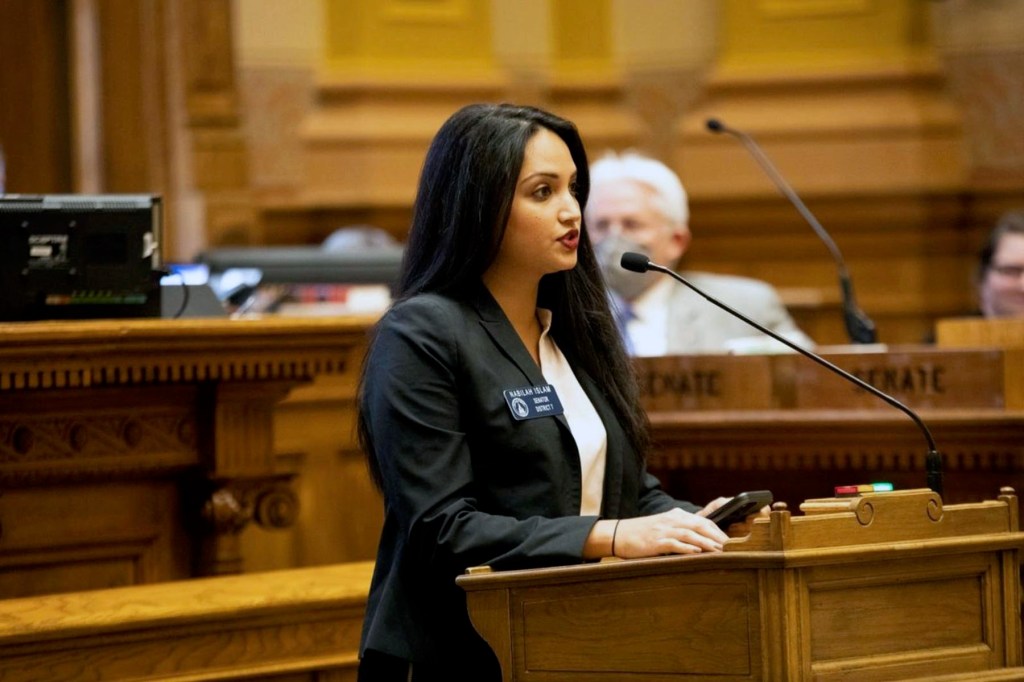
Nabilah Parkes was inside the state Senate chamber in Georgia when she first saw the video. Her Republican colleague, state Sen. Greg Dolezal, had just released a 30-second ad, reportedly made using AI, as part of his campaign for lieutenant governor that depicted Muslims terrorizing white Georgia residents and ended with the message: “Keep Georgia sharia free.” Shariah is the body of Islamic religious law.
The caption for the campaign ad, posted on social media earlier this month, said: “London has fallen. Europe is under siege. In America, the invaders who would rather pillage our generosity than assimilate are roaming Minnesota, New York, and LA. As Lt. Governor, I will fight the enemy before they’re within the gates and keep Georgia safe and Sharia free.”
Parkes, a Democratic state senator at the time, said she immediately turned around, went over to Dolezal’s desk and asked him, “What is this?”
“He refused to look at me and just looked down as if he was in shame,” Parkes said. “It was such a hateful, racist, Islamophobic video that he even came to my desk the next day and said, ‘Feel free to take a shot at me’ — as if he wanted me to even the score.”
Parkes took the shot and decided to run against him. If she wins, she would be Georgia’s first Muslim lieutenant governor.
“This type of hate, this type of Islamophobia, this type of racism has no place in the state legislature, no place in Georgia politics, no place in general,” Parkes said.
About one week after she saw the video, Parkes resigned her seat in the state senate. She is running for lieutenant governor alongside Democrats Josh McLaurin and Richard Wright. There are eight candidates in the race for the Republican nomination: Dolezal, David Clark, Steve Gooch, John Kennedy, Brenda Nelson-Porter, Takosha Swan, Blake Tillery and Jerry Timbs.
In her resignation letter, Parkes wrote that the state Senate is a place where “good ideas go to die.” She said the state was being led by MAGA Republicans, including Dolezal and the current lieutenant governor, who brought “horrible” legislation that put disproportionate financial pressure on women, Black and Brown people and immigrant families. Because the state Senate is majority Republican, Parkes said the chamber “has no guardrails.”
“These bills that keep coming into the legislature attack our immigrant communities, use us as scapegoats and are extremely xenophobic,” Parkes said.
Dolezal’s campaign ad reflects a rise in Islamophobic rhetoric from prominent Republicans and a record-high number of discrimination complaints reported by Muslims, according to the latest data from the Council on American-Islamic Relations (CAIR), the largest Muslim civil rights organization in the country. Muslims make up about 1 percent of the U.S. adult population, according to the Pew Research Center.
In early March, Republican Rep. Andy Ogles, who represents Tennessee’s 5th Congressional District, said on social media that “Muslims don’t belong in American society.” Around the same time, Republican Sen. Tommy Tuberville of Alabama posted “the enemy is inside the gates” on social media atop an image from the September 11, 2001, terrorist attacks and an image of Mayor Zohran Mamdani, New York City’s first Muslim mayor. Tuberville has previously claimed that Islam is a “death cult” and has called for the mass expulsion of Muslims from the country.
Corey Saylor, the research and advocacy director at CAIR, said they received 8,683 claims of discrimination and bias — the highest number since the organization started tracking in 1997. After the Israel-Hamas conflict began in October 2023, Saylor said Muslim Americans saw a surge in Islamophobia that has remained at an all-time high.

While the initial complaints largely related to viewpoints, especially related to Palestine and protest participation, Saylor said he noticed a distinct shift in 2025. More complaints were coming in about incidents of bigotry, including attacks on Islamic religious principles and false allegations that Muslims were going to supplant the Constitution and take over the country.
“The broader narrative of 2025 was powerful public officials telling us freedom comes with conditions,” Saylor said. “You can look the way they look, think the way they think, speak the words they approve of, come from the places they approve of — or else you don’t belong.”
Islamophobia is not new, but Saylor said it feels like it’s “on steroids” with an energy he’s never seen before. And it feels different than the fallout from the 9/11 attacks, he added.
Six days after 9/11, when Islamic extremists killed nearly 3,000 Americans and injured thousands more, then-President George W. Bush went to a mosque and called for civility toward Muslim Americans.
“America counts millions of Muslims amongst our citizens, and Muslims make an incredibly valuable contribution to our country,” said Bush, a Republican. “Muslims are doctors, lawyers, law professors, members of the military, entrepreneurs, shopkeepers, moms and dads. And they need to be treated with respect.”
But now, Republicans are taking a different approach. In December, U.S. Reps. Chip Roy and Keith Self, who represent districts in Texas, launched the Sharia-Free America Caucus. According to Self, the “American way of life is under siege by radicals from a culture waging war against our Constitution and Western values.” The congressional caucus has grown to include more than 50 Republican lawmakers across more than 20 states.
U.S. Rep. Brandon Gill, a Republican member of the caucus who represents Texas’ 26th Congressional District, posted in February on social media: “Islam didn’t come to the United States on the Mayflower. We imported it relatively recently via a suicidal immigration system.”
Saylor said it’s true that Islam didn’t arrive on the Mayflower, but it’s likely that Muslims arrived in America before then — on slave ships. Scholars estimate that between 10 and 40 percent of Africans enslaved and transported to the Americas were Muslim.
In order to combat Islamophobia, Saylor said the two most effective avenues have been lawsuits and public pressure.
“Freedom remains — legally, it’s still enshrined,” Saylor said. “More often what we saw is executive orders, proclamations, memos, investigative threats, withholding of money threats. So what is the solution? A very active defense of the community’s rights.”
As one of only two Muslim state senators in Georgia and a daughter of immigrants, Parkes said she repeatedly pushed back against Republican-led legislation to advocate on behalf of immigrant communities.
“If this is what politics has come to — that you have to throw whole communities underneath the bus to win power, then this is extremely problematic,” Parkes said. “So I’m running for office to give a voice to these marginalized communities. Stop picking on us. We are part of this fabric of Georgia that makes this state great.”
Georgia’s population is becoming increasingly diverse: In 2010, about 56 percent of the state was white and by 2022, that number decreased to 50 percent, according to the U.S. Census Bureau. And in 2024, about 1 in 8 Georgia residents was an immigrant.
Parkes, now 36, said she did not see this level of Islamophobia when she was growing up, including in the years shortly after 9/11. Now, she’s heard from Muslim students in public schools that they’re anxious, being bullied and being called terrorists.
“What’s heartbreaking is as a child, I did not experience this,” Parkes said. “And now my relatives experience this in school, and that’s unacceptable. We’ve gone backwards.”
Parkes said she’s especially concerned about Muslim women in her community who often wear head coverings that make them a more visible target for Islamophobic vitriol. Parkes said her grandma wears a burka and her mom and aunts wear hijabs, so she worries about what will happen if they are attacked without anyone to defend them.
“I want to be able to protect our communities,” Parkes said. “I want to be able to show to these Republicans who are passing these bills left and right that there is a real person behind these bills. They are real people. Just because you may not interact with them in your social circles. We exist.”