





Since President Donald Trump started to wage war against Iran without authorization from Congress and seemingly without much logistical or financial planning, there have been reports that the White House may request that congressional lawmakers authorize emergency supplemental funding to bolster his unauthorized war.
Early reporting on the possible supplemental request suggested that the White House may ask for up to $50 billion in new money. But, according to new reporting by the Washington Post, the Pentagon asked the Trump White House to approve a more than $200 billion request that it wants to send to Congress amid the ongoing war in Iran. The New York Times also separately reported on the details of a $200 billion funding request.
Approving the money could allow the Trump administration to argue that Congress had retroactively authorized the war, legal experts told TPM this month. President Bill Clinton made a similar argument about the war in Kosovo, which began absent Congressional authorization. The Clinton White House argued that funding Congress passed for that conflict doubled as authorization.
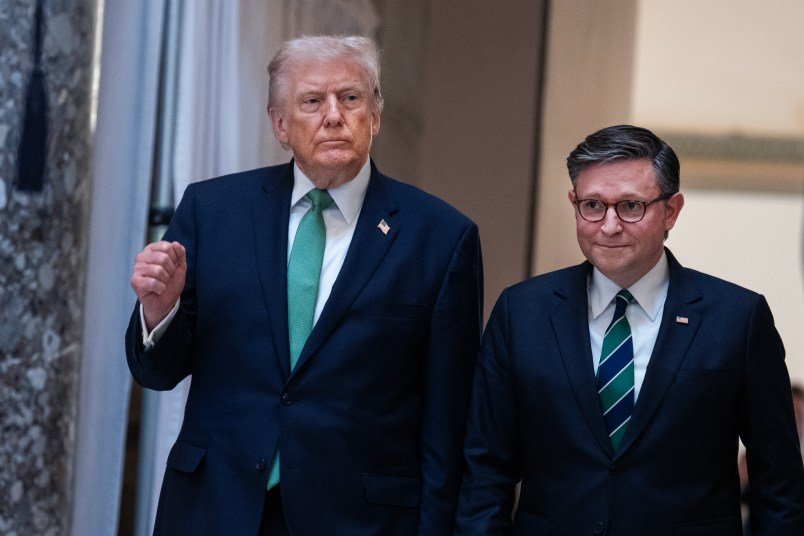
House Speaker Mike Johnson (R-LA) told reporters on Thursday that Congress has to “adequately fund defense” while Trump keeps the war alive. He declined to rule out a possible $200 billion emergency supplemental for the Pentagon in response to the reported request from the Department of Defense, which Secretary Pete Hegseth has conveniently renamed the Department of War.
“I’m sure it’s not a random number,” Johnson told reporters, adding he expected any funding request to be “detailed and specified.”
“So we’ll look at that. But obviously it’s a dangerous time in the world and we have to adequately fund defense, and we have a commitment to do that,” Johnson said.
Shortly before Johnson’s comments on Thursday, Hegseth also refused to rule out a supplemental funding request of that size.
It is unclear if and how much the Trump White House will end up asking Congress to approve for an emergency supplemental. Many on Capitol Hill have been critical of the rapidly growing cost of the Iran war and its impact on American consumers. And Hill Democrats, who have been calling out the Trump administration for not seeking congressional authorization before starting the operation against Iran, may see passing any form of funding for the Iran war as an “implicit” authorization of the war itself.
On top of all of that, a request as big as $200 billion would almost certainly get pushback from lawmakers, especially from Democrats.
It will also be difficult to find a legislative path for such a package in the Senate as a supplemental would have to surpass the Senate’s 60-vote threshold, requiring a group of Senate Democrats to vote in favor of it.
Experts and congressional staffers have also pointed out that the Trump administration has other venues they can rely on for funding before they have to ask for an emergency supplemental.
They have billions to spend from the recently passed One Big Beautiful Bill Act, which included many defense-related provisions. For even more funding, they can wait for the next fiscal year’s appropriations process or use their general transfer authority, which provides $6 billion of flexibility, to move around their current base defense budget.
Earlier this week, they tapped into the general transfer authority and sent Congress a request to move $1.56 billion to replenish stocks, according to documents obtained by TPM. That request included Patriot missiles, Terminal High Altitude Area Defense interceptors, the Aegis Ballistic Missile Defense system and Standard Missile-3 and Standard Missile-6. All of these munitions are in use in the ongoing operation against Iran.
To complicate things even more, it takes years to both contract and manufacture the kinds of munitions that the Iran war is depleting, a senior congressional aide previously told TPM. An emergency supplemental would be redundant as Congress already allocated billions of dollars to expand the factories that make these interceptors and ordered more, the aide explained.
“It takes a year to put this stuff under contract. It takes two years to manufacture the stuff,” the congressional aide told TPM last week. “So when we talk about supplementals, generally, we’re talking about eventually replacing the assets that we’ve already spent, we’ve already used. I think that’s really important — that DoD can’t just turn around and buy these things from the store. We’re talking about placing long-term orders.”