




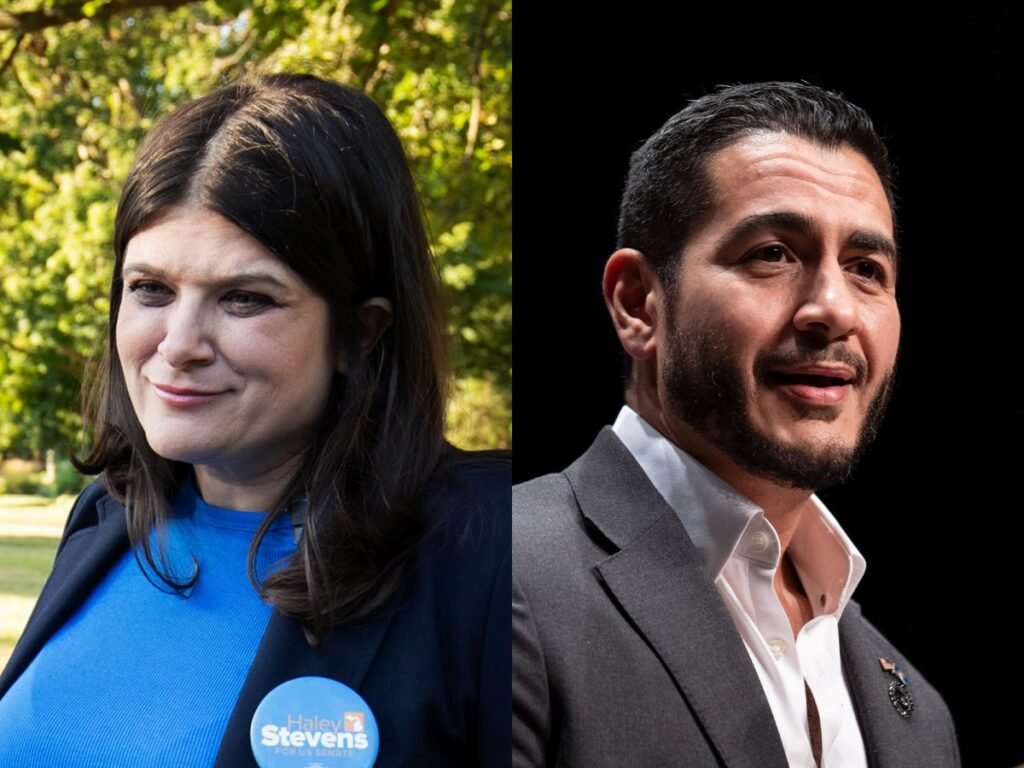
The increasingly acrimonious Senate primary between Rep. Haley Stevens (D-MI) and public health official Abdul El-Sayed draws to a close next week, and with it, the biggest battle yet of the moderates versus progressives proxy war.
It’s a perfect microcosm of the debate roiling the Democratic Party. Stevens, a moderate four-term congresswoman who flipped a previously red seat in 2018, would have once played as the obvious pick for a purple state. El-Sayed, whose only electoral experience is his 2018 loss to now Gov. Gretchen Whitmer (D-MI) and who espouses a lefty platform endorsed by Congress’ most famous progressives, would have once seemed an unnecessary risk against a normie Republican in the general election.
But times have changed. Stevens’ support for military aid to Israel — and extensive funding from AIPAC — have transformed from a common if controversial mainstream Democratic position to one many voters now find to be outright disqualifying. Her backing by Senate Minority Leader Chuck Schumer (D-NY) reeks of the establishment many Democratic voters now abhor.
El-Sayed has accordingly positioned himself as the outsider class warrior promising to shake up a sclerotic system.
We haven’t yet seen these new dynamics tested at scale. Graham Platner versus Sen. Susan Collins (R-ME) was set to be the highest profile test of the insurgent left yet, but the scandal-ridden Platner’s replacement, Troy Jackson, has a more typical political resume. The progressive/democratic socialist wins rocking the country have been mostly confined to mayoral elections in very liberal cities (New York, Seattle, Washington D.C., maybe Los Angeles) and safe blue House seats (New York again, Colorado). In locales where Democratic victory is assured, we have data points suggesting that voters are drifting towards leftier candidates. But does the pattern hold in a must-win, statewide Michigan race?
Polling of the race has been very noisy, clotted with private polls released opportunistically by the campaigns. But Emerson College, considered one of the best pollsters in the industry, released a survey on Thursday showing El-Sayed up on Stevens by a whopping 16 points. Independents, perhaps surprisingly, broke for El-Sayed by a 27-point margin.
It’s a boost to El-Sayed after a buzzy Michigan Education poll showed Stevens tied with Mike Rodgers, the Republican candidates, in a head-to-head, but El-Sayed down 10.
Republicans are banking on the old calculus being the right one. Rogers, who is running it bck after losing narrowly to Sen. Elissa Slotkin (D-MA) in 2024, reportedly said on a donor call of El-Sayed: “If he wins, I think we’re in good shape.” He added that he doesn’t think El-Sayed “likes America,” part of a classically Islamophobic playbook the right is already rolling out, exclusively referring to El-Sayed by his full name, Abdulrahman Mohamed El-Sayed.
The Stevens campaign too has sought to take advantage of racial divisions, particularly the still simmering resentment between many Black voters and Arab American ones stemming from El-Sayed’s public endorsement of the “uncommitted” movement during the 2024 primaries. He has struggled to win over Black voters, a vulnerability Stevens is intent on exploiting.
“I know it’s great to hold, host rallies and have these fun events,” Stevens said at a debate this week. “But everywhere I have gone in Michigan, I have taken the time to visit a minority-owned business.”
She dropped former President Barack Obama’s name constantly, reminding listeners that she worked on the 2009 auto bailout as a young staffer in his administration.
The AIPAC-backed United Democracy Project (UDP) has run ads falsely implying that Obama endorsed Stevens this cycle, and featured an out-of-context quote to make it seem like El-Sayed criticized Michelle Obama.
Stevens has also sought to paint El-Sayed as an inauthentic lightweight, repeatedly referring to him as a “podcaster” during that same debate.
“We don’t need a celebrity candidate,” she said, mocking him for jumping in front of every camera he sees.
El-Sayed has given Stevens as good as he’s gotten. He told Semafor, in much-scrutinized comments: “Haley Stevens is a suit with a large AIPAC bank account, that’s it. I hope maybe they find some way to teach her how to string together two coherent sentences.”
He paints Stevens as a pawn of corporations, hammering her on donations from both AIPAC and utility companies. (Stevens denied the latter, though FEC records show that she took donations from energy company PACs to her House campaign committee and transferred them to her Senate one.)
The primary has become downright nasty, with a clip of El-Sayed calling Stevens “the least capable candidate in America” circling widely Friday night.
Stevens responded: “Abdul, we were both on the ballot in 2018. I was capable of winning my competitive primary and general election. You lost.”
“You lost by over 20 points to Gretchen Whitmer and you will lose to Mike Rogers by talking like this,” she added. “Everyone in America understands you want to blame all of your problems on Jewish Americans.”
So who’s the riskier candidate for a state Democrats must win if they hope to hold the Senate? An establishment Democrat or an untested progressive? And do Democratic voters care?
Stevens hasn’t mustered the grassroots enthusiasm of El-Sayed, and premises her pitch on experience serving in a hated Congress and an Obama project from 17 years ago. El-Sayed has called for defunding the police (though he was explicit about his definition of shifting money from enforcement to address underlying systemic problems) and likely reads as more “radical” than Stevens both due to his progressive ties and his race. Democrats are fearful of making a mistake typical of Republicans in the Trump era, fumbling winnable seats because the candidate who wins the primary has been selected by the most engaged and angriest voters (Blake Masters, Kari Lake, Doug Mastriano, Herschel Walker, Don Bolduc, Mark Robinson) and is too fringey for the general electorate.
But with the Democratic establishment at its lowest ebb, its attempts to back Stevens, who it sees as the better candidate, might fall short. And maybe a further-left Democrat isn’t comparable to the right-wing misfires; advocating for universal healthcare, after all, is different than pushing Christian nationalism.
It’ll be a telling, and important, data point as Democrats grope for their way back out of the political wilderness. But they probably wish it was playing out in a race less critical for Senate control.