Sky York Journal
New York City Mayor Zohran Mamdani knows what they’re saying about his grocery plan.
Conservative media outlets and right-wing commentators have, for more than a year, been practically apoplectic about Mamdani’s push to open five municipal stores to sell discounted food. Local Republicans have responded to the initiative by comparing Mamdani to Fidel Castro and Hugo Chavez. Last year, as Mamdani made the plan a central plank of his campaign, Fox Business published a dramatic piece featuring interviews with “descendants of socialism” from Eastern Europe and Cuba suggesting Mamdani’s agenda was reminiscent of the “vivid memories,” “tales of woe” and “scars” they experienced.
Now, the plan is underway. The first store is set to open its doors by the end of next year, and Mamdani is thoroughly unmoved by the backlash. In a conversation with TPM last week, the mayor dug into the details of his grocery store plan and brushed off the critics.
“If I listen to that commentary every day, I would become afraid of my own shadow,” Mamdani said with a laugh. “And I think, for too long, we have allowed the right to dictate the entirety of the discussion. And we have limited ourselves to a response to a landscape that they have created.”
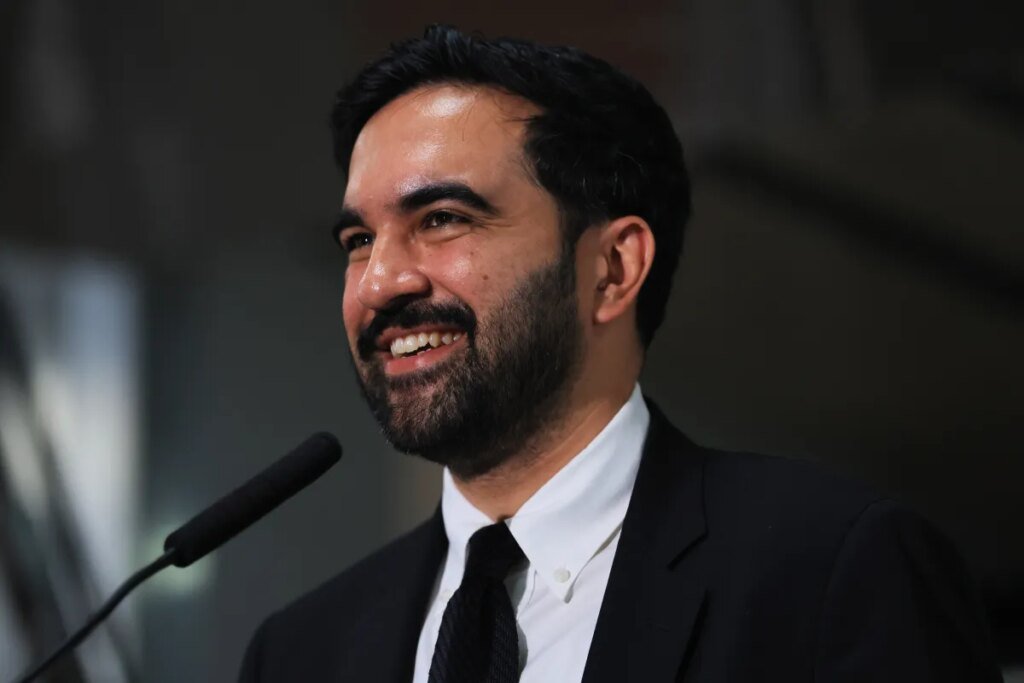
As he sat in the Governor’s Room of City Hall, Mamdani emphasized his words by tapping his hand against the large conference table. It’s a gesture that would go unnoticed if it were not for his signature silver rings gently rapping against the wood. The sound served as periodic punctuation as he expressed his frustration with the limitations of Democratic politics as usual and his enthusiasm for the city-run stores.
“It is time for us to ask ourselves, what is our party for?” he asked. “And to me, the answer has to be the working class. It’s the only majority in this country. And then what can we do to materially change the lives of those working class New Yorkers or Americans?”
Those are the people who inspired Mamdani’s groceries initiative. The mayor explained that he settled on the idea during his campaign last year based on conversations with city residents.
“If you ask New Yorkers, .. what are the costs that you’re reckoning with as part of the skyrocketing cost of living crisis in our city? … What is pushing you to reconsider if you should be living in this city? … Again and again, you hear about housing, childcare, groceries,” Mamdani said. “We’d hear about public transit, we’d hear about other things, but groceries would always be up there.”
Data shows it’s gotten far more expensive to eat in New York City. A report released by the state comptroller last year showed food prices in the metropolitan area were up over 25 percent since 2019. And as Mamdani and his advisers looked at ways to confront the issue, they became adamant new approaches were needed.
“When everyone is telling you that prices are too high, the common refrain is therefore we should subsidize the private market further,” said Mamdani. “And yet, what we’ve seen is that we’ve explored those kinds of strategies here in New York City. They have not had a substantial impact on the cost of groceries.”
The plan is rooted in a very New York “tradition.” Mayor Fiorello La Guardia, a progressive New Deal Republican who steered the city through the Great Depression, opened public markets that gave street vendors support and space for their businesses. That vision has continued with Essex Market, a warren of shops and restaurants on the Lower East Side that the city has operated since the 1990s.
Mamdani describes La Guardia as “an inspiration each and every day.” One of New York’s five new grocery stores is being constructed at La Marqueta in East Harlem’s El Barrio, a site that was home to one of the original 1930’s markets. More recently, a similar public grocery store initiative has begun in Atlanta.
Despite the histrionics — including dire warnings from Fox News and right-wing think tankers that Mamdani’s stores could cause widespread food shortages — the actual plan is fairly limited in its scope. There will just be five stores (one in each of New York City’s boroughs). In addition to La Marqueta, another is planned for a city-owned site at Hunts Point in The Bronx. That store, which has been dubbed The Peninsula, is slated to be the first to open towards the end of next year. The other three locations, which will be in Brooklyn, Queens, and on Staten Island, have not been identified yet. Mamdani has pledged to open all of them by the end of his term in 2029.
Inside the stores, a slate of items that Mamdani’s team has dubbed a “core basket” will be offered at a 30 percent discount that will be adjusted monthly and pegged to the market rate. This includes produce, meat, seafood, dairy, and a selection of pantry staples. Other items will be on sale at standard prices. The city estimates this will save customers roughly $90 per month.
Those market rate costs for the majority of goods in the grocery stores are hardly in line with the visions of Havana spun by the right. The “government-run” moniker conservatives have slapped on the project is also an exaggeration. Mamdani’s grocery stores are actually a public-private partnership. The New York City Economic Development Corporation currently has proposals out looking to rent privately owned sites for the final three stores. They also have accepted bids from experienced operators to run all of the venues.
Some of the criticism of the plan has been based on its potential cost to taxpayers. The city initially invested $70 million to cover construction and real estate expenditures associated with the five sites. According to officials, with solicitations for sites and operators ongoing, the final annual cost of the program is not clear. However, they are confident having the spaces paid for will be sufficient incentive to enable the store operators to offer the “core basket.” If necessary, the city may also provide further subsidy beyond covering real estate capital costs to ensure operators can stock the discounted items. Furthermore, they expect the NYCEDC’s competitive bidding process will help identify companies who can keep the stores’ overhead low.
In the interview with TPM, Mamdani insisted the plan will be “sustainable.” And, thus far, the mayor has a track record of managing the costs of his ambitious programs. This year, Mamdani, who inherited an approximately $12 billion deficit when he took office in January, balanced the city budget. While much has been made of the fact that the feat required some help from the governor’s mansion and a delay in pension payments that will need to be dealt with down the road, Mamdani made up nearly half the difference by finding new revenue through taxes on the wealthy and cost-saving measures like cutting unnecessary overtime.
Joseph Hernandez, the Republican candidate for state comptroller, has been one of the more vocal critics of Mamdani’s municipal grocery stores. He’s unveiled estimates claiming the plan could cost $200 million. There are some issues with that figure. Along with the initial $70 million in construction costs and an estimated $106 million in projected operating costs, Hernandez’s tab includes a supposed $30 million that he says will be lost by other businesses from competing with the stores.
“We can absolutely afford it,” Mamdani said with a laugh. “We are a city budget that has significantly north of $100 billion on an annual level — and we already spend about $850 million in programs that seek to address food insecurity, ranging from our school system to funding food pantries.”
“What we’re talking about here is a drop in the bucket of what the city already spends,” he added. “But one that will be felt by every single New Yorker who goes to these stores.”
Mamdani further argued that those who raise questions about the price of social programs “prefer not to see the cost today” of the underlying issues those initiatives seek to address.
“We are dealing with the costs of food insecurity every single day. We’re sitting down to talk in the wealthiest city in the wealthiest country in the history of the world and yet one in four New Yorkers are in poverty,” Mamdani said. “It is not tenable, it is not acceptable.”
For the mayor, the situation calls for a different kind of politics. He described himself as “unwilling” to simply point at the problem “and then hope that somebody comes up with a solution.”
“This is a city of innovation. It’s a city of imagination. It’s time we bring those kinds of ethos to our politics as well,” Mamdani declared.
The idea that the new stores will hurt other businesses has been one of the more persistent arguments from critics of the plan. A group of minority-owned bodegas and supermarkets has even sued to stop the initiative. Yet Mamdani argues his stores are fundamentally different, particularly from bodegas which typically offer ‘round-the-clock service and core items that won’t be available in the municipal shops.
“The biggest things that drive revenue for bodegas are tobacco, lottery tickets, and alcohol. We’re not selling those,” Mamdani explained. “Our goal here is not to compete with fundamental parts of New York City.”
Mamdani, who noted there are thriving bodegas in the immediate vicinity of the existing public Essex Market, also framed it as fairly simple math.
“We’re speaking about a city that has north of 10,000 bodegas, north of a thousand different grocery operators. We’re talking about five city-run grocery stores,” he said emphatically as his ring tapped against the wooden table.
As they select locations for the stores, city officials are looking for neighborhoods where there isn’t much competition. They are aiming for locations with insufficient grocery store options as well as a high rate of residents accessing public benefits. Though the goal is to ensure the discounted food will be easily accessible for lower income New Yorkers, the stores will be available to anyone who wants to shop at them.
“These are stores for everyone,” Mamdani said.
In building out his vision for the municipal grocery stores, Mamdani named his chief of staff, Elle Bisgaard-Church, who he calls his “left hand,” as a key force behind the project. He also pointed to Deputy Mayor for Economic Justice Julie Su, the highest ranking City Hall official with the stores in their portfolio, and NYCEDC Executive Vice President Jamie Horton as being among the key officials overseeing the plan.
Speaking to TPM, Horton said one key aspect of the program for Mamdani is ensuring that the stores will be a “pleasant experience” without “stigma.” The solicitations for operators and sites specify the visual language and design elements that will be part of creating an elevated environment inside the shops.
“It’s really important that this is an example of public excellence, that the public sector can deliver a high quality experience. It’s also about providing a service … that treats folks with dignity, that this isn’t a handout for folks, it’s that the government is delivering for its people,” Horton said.
Overall, Mamdani said a core goal of the project is making a real change in the environment for city residents.
“I am tired of the fact that politics has increasingly become an act of describing working peoples’ struggles as opposed to putting forward what you will do about those struggles,” he said, before asking, “How are you going to deliver them a different reality?”
That ethos and desire to take concrete steps to address cost of living has been the central plank of Mamdani’s platform. As he ran for office last year, the grocery stores were one of the highest profile parts of his campaign along with a partial rent freeze and a plan for fast, free city buses. Mamdani delivered on the rent freeze for certain stabilized units in June. While the plan for free buses has run into legislative opposition, in July, Mamdani and Gov. Kathy Hochul unveiled a road map to speed up service.
At every turn, Mamdani’s various proposals have faced backlash and questions about costs. The criticism has been amplified by Mamdani’s membership in the Democratic Socialists of America. All of this has, for better or worse, made Mamdani a national figure who has received both positive attention and ire from President Donald Trump. Last June, after Mamdani won the Democratic primary en route to City Hall, Trump took to social media and blasted him as “a 100% Communist Lunatic.” Less than five months later, after Mamdani was victorious in the general election, the two had a warm meeting in the Oval Office where the president heaped praise on the new mayor.
“I met with a man who’s a very rational person. I met with a man who wants to see — really wants to see — New York be great again,” Trump said, adding, “I’ll be cheering for him.”
Along with the rhetoric, Trump’s allies have also played their part in the opposition to Mamdani’s grocery plan. One of the legal complaints from store owners was filed with the America First Policy Institute, a right wing dark money group chaired by Larry Kudlow, the former director of the National Economic Council in the Trump White House.
Mamdani smiled broadly as he offered some choice words for Kudlow.
“Larry must love paying a lot of money for eggs,” Mamdani said, adding, “There will always be opposition wherever there is innovation and wherever there is imagination. And we welcome it. We are fully confident in the legality of this program and even more so than the legality, the urgent necessity of it.”
While the mayor clearly has his critics, Mamdani and the swirl of national buzz around his rise helped turn “affordability” into one of the major talking points of this election cycle. And, in New York, the most recent polling shows his popularity has surged to nearly 70 percent favorability.
Mamdani believes his fellow Democrats need to be less preoccupied with their detractors.
“I think you simply have to prepare and expect for this kind of backlash. What it is, is a backlash to any kind of change. And if you want to avoid backlash, then all you will do is just steward the status quo. And that is exactly what has gotten us to this point,” he said. “It is critically important that we stop the act of constructing an ever-lowering ceiling on our ideas.”
For Mamdani, his grocery stores epitomize this ambitious, unafraid vision and approach.
“That is what is so exciting to me,” he said. “Politics so often is something that has to be translated to someone who lives outside of the political world. There is no translation required about cheaper groceries. You understand it when you’re checking out.”
“For too long, politicians have had things to say and they haven’t had anything to do,” he added. “And it’s time to make this city an example of what we can do for people.”