
Sky York Journal
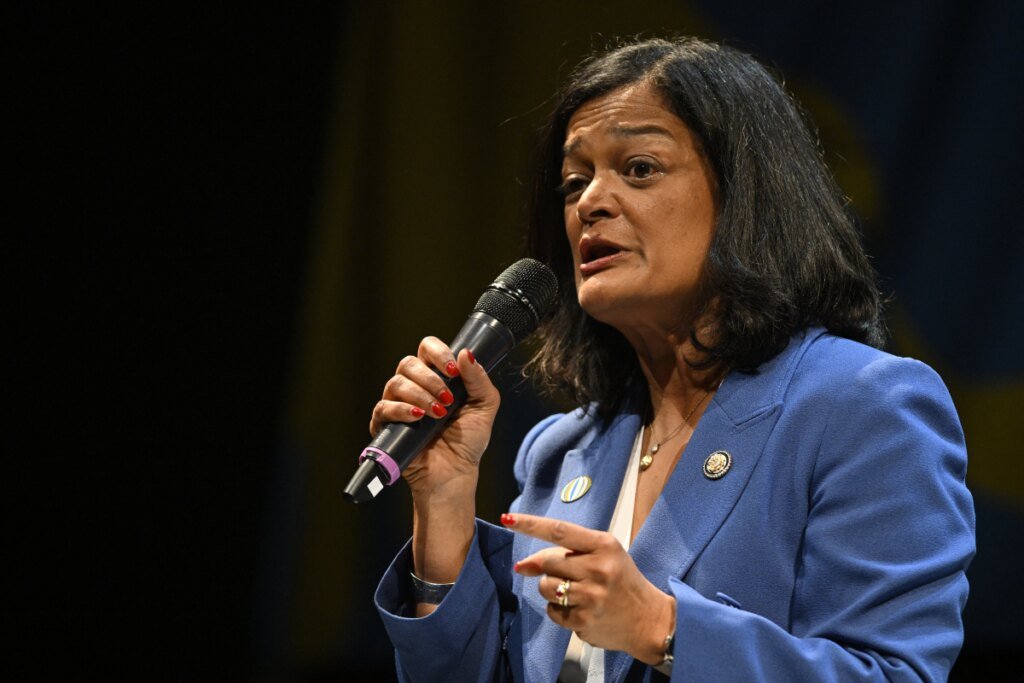
Rep. Pramila Jayapal (D-WA) has not been getting much rest. However, she says her sleeplessness isn’t due to “horrible things” as it has been through much of President Donald Trump’s second term. Instead, in the wake of the blue tsunami election on Nov. 3, Jayapal has been consumed with “excitement,” “amazement” and “planning” for the new Democratic Congress.
“I’m feeling really great about the path forward and also feeling a deep urgency to make sure that our majorities meet the moment,” Jayapal said in an interview with TPM Friday.
As one of the chair emeriti of the Congressional Progressive Caucus, which grew its ranks by over 20 members with the wave of Democrats voters in red and blue states just sent to Capitol Hill, Jayapal will be an influential voice. She talked to TPM about the part she hopes the Democrats’ left wing will play in the new Congress as it weighs questions over its own leadership, a potential Trump impeachment and major legislation.
Jayapal believes it is progressives’ role to “push” Democrats to deliver on an ambitious agenda. She sees the election results, which were driven by a surge in voting and pronounced shifts in red states, as a “mandate” for Democrats to deliver results rather than a “green card to forever support” from the bloc of voters who came out to back them.
“They’re giving us a shot,” she explained. “We have to make sure that we respond with bold policies that really do address the urgency and the anger that they came to the polls with.”
The Democratic candidates who won last week were a mix of progressives and moderates. Some seemed to straddle traditional conceptions of that divide. Jayapal went even further and argued the overall results are a win for progressivism since so many agenda items that once were priorities on the left have now become more mainstream for the party at large.
“I always say being a progressive just means you’re the first to the best idea and the most resonant idea with the working public,” Jayapal said, later adding, “If the so-called moderate … wing of candidates is talking about getting money out of politics … ending the war, and affordability, and … reigning in ICE, and stock trading bans, well, great. They don’t need to call themselves progressive, but the progressive movement already won.”
She cited Medicare for All as another policy that was once a progressive cause and now has more popular support among Democratic elected officials and voters. Jayapal also said it’s “absolutely at the top” of her agenda for the next two years.
Along with Medicare for All, Jayapal is focused on campaign finance reform, a congressional stock trading ban, “ending the war in Iran,” a collective bargaining bill, living wage legislation, voting rights, rolling back Medicaid cuts enacted by Trump and Republicans in 2025, extending Obamacare subsidies, and “reigning in ICE and reforming ICE.” It’s a packed list of priorities.
Dealing with Trump’s mass deportation and detention system will be particularly important for Jayapal as chairwoman of the House Judiciary Subcommittee on Immigration Integrity, Security, and Enforcement. While the president’s “One Big Beautiful Bill” already allocated approximately $190 billion to the Department of Homeland Security and gave ICE roughly seven times its annual budget earlier this year, Jayapal believes there are big changes to the agency that can be done “very early” and “will happen” in the new Democratic Congress.
“We can do major reforms to the way ICE works,” said Jayapal before listing off several ideas, “That is requiring a judicial warrant for any ICE agent to arrest anybody on the streets or in their homes, banning masks, actually having accountability and the ability for ICE agents to be held accountable by local and state entities for abuses on the streets.”
And Jayapal isn’t giving up on reversing some of the huge surge in ICE funding that was passed by Republicans earlier this year.
“The bigger question of clawing back the money has to be done,” she said. “We can reappropriate it. We can claw it back and put it towards health care, put it towards childcare, put it towards other things. And so, we’re looking at all the ways to do that.”
The new Congress has brought with it the possibility of a potential Trump impeachment. However, with the president having survived two prior impeachment trials, Jayapal only wants to go down that road if it has a surer chance of success. Current Democratic leadership has expressed similar sentiments.
“If we pursue a third impeachment, we have to make sure the Senate will convict,” she said. “A third impeachment without a conviction, I think, undermines our case that we can hold an unaccountable president accountable. And I think that is a problem if the American people start to believe that we can never impeach a president.”
Jayapal also wants to see Democrat-led committees investigate Trump over things like his Qatari jet and his ties to Jeffrey Epstein. In her view, information unearthed in those probes could, as she put it, create “the roadmap for a potential impeachment.” Jayapal also said fresh controversies or an effort to fight the results of this past election like the one Trump mounted after his loss in 2020 could provoke a push to oust him.
“If he does something else now — given the majorities in the Senate — If he were to try and not seat us … if he were to do something else at this point — the way he did on January 6th — that would be a totally different calculus,” Jayapal said, later adding, “It’s not that I don’t want to impeach him. I would impeach him today if I could … if I knew that he would get convicted.”
The possibility of impeachment and new investigations of the Trump administration has provoked some debates about whether Democrats should be focused on retribution or their own political priorities. Jayapal calls that dichotomy a “false premise.”
“I don’t think anyone’s focused with getting even. I think it’s about making sure that the American people have not been bilked by a bunch of corruption that’s come from Trump, and his cronies, and giant corporations that have been allowed to get away with things that have actually undermined the ability for Americans to get the things that they really need, like healthcare,” Jayapal said.
Jayapal went on to explain that she thinks there’s a “direct tie” between malfeasance and affordability.
“There’s plenty of money to do very corrupt things like fund ICE and CBP to the tune of hundreds of billions of dollars, or fund an illegal war of choice in Iran, and then the violation of rights,” Jayapal said, adding, “They’re very closely intertwined, and we just have to make the connections so that people understand that, when Trump funds his ballroom, or gets a Qatari jet, or a new golf course, it’s at the expense of the American people. It’s at the expense of them actually being able to get health care and childcare.”
In the past , Democrats’ previously slim House majority gave the progressive bloc heavy sway since unity was vital for the party to pass its agenda. However, Jayapal isn’t worried about their influence being diluted.
“I think a larger Democratic majority is always good,” she said, explaining that it avoids a situation where a “couple of people” can block “progress.” She pointed to the way former Sens. Joe Manchin (D-WV) and Kyrsten Sinema (R-AZ) acted as swing votes. Jayapal also later cited Rep. Josh Gottheimer (D-NJ), of the bipartisan Problem Solvers Caucus, as another example.
“I don’t know why they’re called centrists,” Jayapal said. “They don’t reflect the center of the country and they reflect a tiny minority of people who want to continue to profit off of whatever we do.”
While Jayapal does not see the Progressive Caucus’ influence waning, she conceded its approach will have to change in the new Congress. Jayapal predicted they will move from using tight whip counts for leverage to playing an inside-outside game where they channel activist energy to move the needle.
“I think the way that the Progressive Caucus uses its power shifts and we use the outside anger and frustration to drive an inside attention and desire to fight,” said Jayapal. “I just think there’s no caucus better than the Progressive Caucus for not only organizing on the inside, but also organizing on the outside. We are the closest to the base.”
Jayapal views that position as a critical one.
“I think it is the energy of the caucus and the ability for us to continue to sort of be the push force within the Democratic Caucus and with our leadership that will matter,” she said.
Of course, there are some questions about who will lead the Democratic majorities in the House and Senate. And those doubts have largely been fueled by frustrations with the current minority leaders, Sen. Chuck Schumer (D-NY) and Rep. Hakeem Jeffries (D-NY), among the party’s progressive base.
Jayapal is ready to see a new Senate leader. However, she has another take on Jeffries.
“I think, first of all, the House and the Senate are really different. I mean, I was very clear going back six months that Chuck Schumer needed to be replaced. Chuck Schumer did not meet the moment,” Jayapal said.
She pointed to the fact the House opposed some of Trump’s Cabinet picks who were ultimately confirmed by the Senate.
“We had to push on the House side. He let so many of the Cabinet appointments go through without a challenge early on which is what fueled a lot of the anger,” Jayapal said of Schumer. “People put Jefferies and Schumer in the same category. And I understand why, but I also think they are very different.”
She also complimented Jeffries for his handling of the shutdown and opposition to ICE and CBP funding. But House leadership is another area where Jayapal sees progressives’ influence as a push force.
“I don’t want that to seem like there’s not gonna be a push. I am still pushing very hard because I want to see him embrace Medicare for All and make sure that we get a markup and have his leadership in getting the requisite number of votes,” she said of Jeffries.
Jayapal also pointed out that alternatives to Jeffries have not emerged.
“I’ve always said you can’t beat somebody with nobody. There is no challenger right now. If there was, I think, you know, obviously, that changes everybody’s calculus,” said Jayapal.
Ultimately, Jayapal said Jeffries’ success will be defined by whether he can complete ambitious goals and not be “tinkering around the edges.”
“I think he will have a relatively short rope to show that kind of urgency and perhaps abandon some of the caution that everybody notes as one of his one of his qualities,” Jayapal said. “He is cautious and sometimes that can be good, but in a moment where you have this kind of anger, and need, demand for bold reform, in order for him to be successful and to hold a speakership, he’s going to have to be able to respond very quickly to that.”
As far as her own response, Jayapal said she is not interested in running for speaker. It’s another area where she prefers to play something of an outside game.
“I’m focused on using my platform to push for the boldest possible change,” Jayapal said, adding, “I think a good speaker appreciates that progressives like me give him the push and the space to do those things that maybe he needs the cover to do.”