




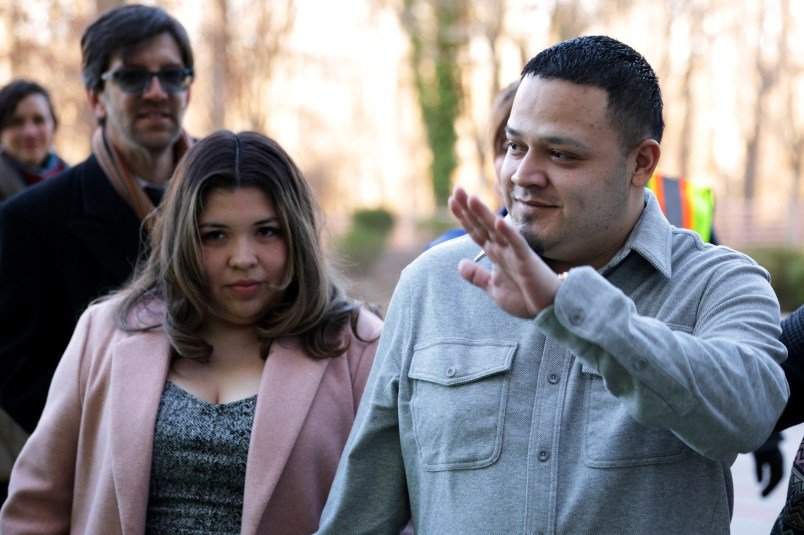
A federal judge in Nashville has dismissed the criminal case against Kilmar Abrego Garcia, ruling that he was the victim of vindictive prosecution by the Trump Justice Department.
The indictment of Abrego Garcia was a reprisal for him having prevailed in his civil case against the government for wrongfully deporting him to El Salvador, U.S. District Judge Waverly D. Crenshaw, Jr. ruled:
The objective evidence here shows that, absent Abrego’s successful lawsuit challenging his removal to El Salvador, the Government would not have brought this prosecution. The Executive Branch closed its investigation on the November 2022 traffic stop. Only after Abrego succeeded in vindicating his rights did the Executive Branch reopen that investigation.
In ruling in favor of Abrego Garcia, Crenshaw pointed the finger squarely at acting Attorney General Todd Blanche, who was the deputy attorney general when the criminal investigation was opened: “Blanche started the investigation to implicate Abrego. He did so to justify the Executive Branch’s decision to remove him to El Salvador.”
The dismissal of the criminal case is another dramatic turn in a central saga of the Trump II presidency: The unlawful removal of Abrego Garcia to prison in El Salvador despite an immigration judge’s order barring his deportation there and the refusal of the Trump administration to abide by court orders, including the Supreme Court, to facilitate his return.
Ultimately, the Trump administration did bring Abrego Garcia back, but only after obtaining an indictment against him on human smuggling charges that arose from an investigation that was conspicuously re-opened after he had prevailed in his civil case.
After Abrego Garcia was freed from pre-trial detention in Tennessee in August, he was quickly re-detained by ICE and held until U.S. District Judge Paula Xinis of Maryland granted his release in December. She had previously barred the administration from deporting him without prior notice. Over the ensuing months, the Trump administration has continued to try to deport Abrego Garcia but this time to various third countries in Africa, most recently Liberia.
Abrego Garcia has for months told Xinis that he is willing to go to Costa Rica, and Costa Rica has publicly said it is willing to accept him and give him asylum there. But the administration has refused to accept that option.
So long as the criminal case was hanging over him and the conditions of his pre-trial release barred him from leaving the country, Abrego Garcia was unable to go to Costa Rica on his own. In dismissing the case, Judge Crenshaw also ended the conditions of Abrego Garcia’s pre-trial release, which may open the door for him to go to Costa Rica finally and bring an end to his 14-month saga that has received international attention and opprobrium.
In a statement following the dismissal, Abrego Garcia’s lead criminal attorney Sean Hecker said:
Kilmar Abrego Garcia is a victim of a politicized, vindictive White House and its lawyers at what used to be an independent Justice Department. We are so pleased that he is a free man. Justifiably so. As this Administration continually chips away at our democracy, we remain grateful for an independent judiciary that will dispassionately apply binding precedent to the facts.
The procedural path to dismissing the case was not straightforward. Judge Crenshaw originally found in December that Abrego Garcia had established a presumption of vindictive prosecution, a high bar which few criminal defendants ever manage to clear. That ruling shifted the burden to the government to establish that it was a legitimate prosecution. Crenshaw held a daylong evidentiary hearing in February was the government’s chance to rebut the presumption, but it failed to do so.
Under the law, Crenshaw ruled, he was not required to inquire further: “While the Court finds insufficient evidence of actual vindictiveness, the Court concludes that the Government has failed to rebut the presumption of vindictiveness.”
Had the government succeeded in rebutting the presumption of vindictiveness, Abrego Garcia would still have had a chance to show actual vindictiveness through additional evidence and arguments. But in a clever maneuver, the judge had put off ruling on some of the thorny discovery issues and objections raised by the government, including executive privilege, reasoning that he might never need to cross that bridge if the government failed to rebut the presumption. That careful sequencing avoided lengthy appeals on complicated issues that could have dragged out a case that the Trump DOJ was already slow-rolling.
The government put forward federal prosecutor Robert McGuire, who was the interim U.S. attorney when the case was reopened, as a dispassionate career prosecutor who was solely responsible for the decision to seek an indictment of Abrego Garcia. He was the prime government witness in the February evidentiary hearing, and he presented as credible and earnest. But the case was much bigger than him, as Crenshaw tries to show with an unusual eight-plus page timeline that takes up a quarter of his written opinion.
Ultimately, Crenshaw concluded that the vindictiveness pre-dated McGuire’s involvement in the case. “The reopening of the closed HSI investigation is the source of the vindictiveness,” Crenshaw ruled. Everything that came after the vindictive reopening of the case, Crenshaw concluded, was contaminated by “the retaliatory taint that set the investigation, indictment, and Abrego’s return in motion.” McGuire merely “inherited the reopened, tainted investigation and carried it through to completion.”
If McGuire wasn’t the culprit, who was? Crenshaw directs his ire at Blanche and Blanche’s direct report, Associate Deputy Attorney General Aakash Singh.
“Blanche’s now unrebutted public statements tying the reopened investigation to Abrego’s successful lawsuit taints the investigation with a vindictive motive,” Crenshaw ruled. “That vindictive taint continued with Singh’s close substantive oversight of McGuire’s and his prosecution team’s work leading to the indictment.”
While Blanche is responsible for the vindictive investigation, Crenshaw concludes, “Singh’s ongoing close involvement” with the prosecution “ties the tainted investigation to the indictment.”
Their involvement undermined the government’s claim that McGuire was acting independently, Crenshaw ruled: “McGuire is a talented, gifted prosecutor brought into a tainted investigation, handed a star witness by Main Justice to obtain a tainted indictment.”