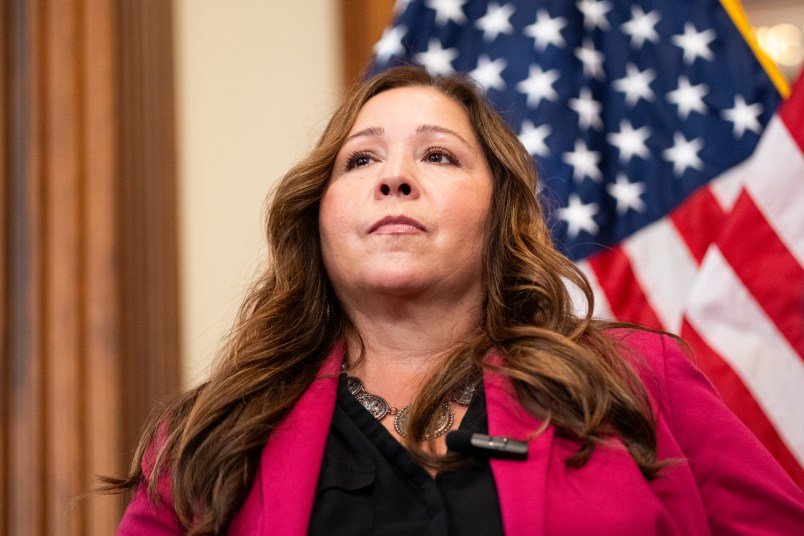
UNITED STATES - OCTOBER 21: Rep-elect Adelita Grijalva, D-Ariz., participates in House Minority Leader Hakeem Jeffries' news conference in the U.S. Capitol on Tuesday, October 21, 2025. (Bill Clark/CQ-Roll Call, Inc ...UNITED STATES - OCTOBER 21: Rep-elect Adelita Grijalva, D-Ariz., participates in House Minority Leader Hakeem Jeffries' news conference in the U.S. Capitol on Tuesday, October 21, 2025. (Bill Clark/CQ-Roll Call, Inc via Getty Images)MORE LESS
After seven weeks of unprecedented delays, House Speaker Mike Johnson (R-LA) on Wednesday finally formally swore in Representative-elect Adelita Grijalva (D-AZ).
Johnson, later, also tried to use another short-lived excuse for delaying the swearing in ceremony, pointing to the delay in then-House Speaker Nancy Pelosi’s (D-CA) swearing in of Rep. Julia Letlow (R-VA), which happened about a month after her election in 2021.
In October, Arizona Attorney General Kris Mayes (D) and Grijalva even sued the Speaker for delaying the process, pointing to Johnson’s “inconsistent” reasoning for refusing to seat Grijalva.
Mayes and Grijalva requested a declaratory judgment from the court saying that if Johnson won’t administer the oath, it can be administered “by any person authorized by law to administer oaths under the law of the United States, the District of Columbia, or the State of Arizona.”
Johnson swore in two Republicans during a pro forma session earlier this year.
Johnson, later, also tried to use another short-lived excuse for delaying the swearing in ceremony, pointing to the delay in then-House Speaker Nancy Pelosi’s (D-CA) swearing in of Rep. Julia Letlow (R-VA), which happened about a month after her election in 2021.
In October, Arizona Attorney General Kris Mayes (D) and Grijalva even sued the Speaker for delaying the process, pointing to Johnson’s “inconsistent” reasoning for refusing to seat Grijalva.
Mayes and Grijalva requested a declaratory judgment from the court saying that if Johnson won’t administer the oath, it can be administered “by any person authorized by law to administer oaths under the law of the United States, the District of Columbia, or the State of Arizona.”
House Democrats tried to raise the issue multiple times on the House floor during the pro forma sessions, but Republicans refused to recognize them.
Johnson swore in two Republicans during a pro forma session earlier this year.
Johnson, later, also tried to use another short-lived excuse for delaying the swearing in ceremony, pointing to the delay in then-House Speaker Nancy Pelosi’s (D-CA) swearing in of Rep. Julia Letlow (R-VA), which happened about a month after her election in 2021.
In October, Arizona Attorney General Kris Mayes (D) and Grijalva even sued the Speaker for delaying the process, pointing to Johnson’s “inconsistent” reasoning for refusing to seat Grijalva.
Mayes and Grijalva requested a declaratory judgment from the court saying that if Johnson won’t administer the oath, it can be administered “by any person authorized by law to administer oaths under the law of the United States, the District of Columbia, or the State of Arizona.”
After initially saying he would swear her in “as soon as she wants,” Johnson quickly pivoted to saying he wouldn’t do it until the House is back in session, linking that eventuality to Senate action on the government shutdown.
House Democrats tried to raise the issue multiple times on the House floor during the pro forma sessions, but Republicans refused to recognize them.
Johnson swore in two Republicans during a pro forma session earlier this year.
Johnson, later, also tried to use another short-lived excuse for delaying the swearing in ceremony, pointing to the delay in then-House Speaker Nancy Pelosi’s (D-CA) swearing in of Rep. Julia Letlow (R-VA), which happened about a month after her election in 2021.
In October, Arizona Attorney General Kris Mayes (D) and Grijalva even sued the Speaker for delaying the process, pointing to Johnson’s “inconsistent” reasoning for refusing to seat Grijalva.
Mayes and Grijalva requested a declaratory judgment from the court saying that if Johnson won’t administer the oath, it can be administered “by any person authorized by law to administer oaths under the law of the United States, the District of Columbia, or the State of Arizona.”
Grijalva was elected following a special election to replace her late father, Rep. Raúl Grijalva (D-AZ), on Sept. 23 but was not sworn in: Johnson kept the House on vacation, holding weeks of pro forma sessions, despite an intense push from congressional Democrats to let their newest member take her seat.
After initially saying he would swear her in “as soon as she wants,” Johnson quickly pivoted to saying he wouldn’t do it until the House is back in session, linking that eventuality to Senate action on the government shutdown.
House Democrats tried to raise the issue multiple times on the House floor during the pro forma sessions, but Republicans refused to recognize them.
Johnson swore in two Republicans during a pro forma session earlier this year.
Johnson, later, also tried to use another short-lived excuse for delaying the swearing in ceremony, pointing to the delay in then-House Speaker Nancy Pelosi’s (D-CA) swearing in of Rep. Julia Letlow (R-VA), which happened about a month after her election in 2021.
In October, Arizona Attorney General Kris Mayes (D) and Grijalva even sued the Speaker for delaying the process, pointing to Johnson’s “inconsistent” reasoning for refusing to seat Grijalva.
Mayes and Grijalva requested a declaratory judgment from the court saying that if Johnson won’t administer the oath, it can be administered “by any person authorized by law to administer oaths under the law of the United States, the District of Columbia, or the State of Arizona.”
A floor vote on the bill is reportedly expected in the first week of December. But even if the House successfully passes the bill, Republicans expect it to go nowhere in the Senate. Senate GOP leadership have not committed to bringing it up for a floor vote.
Grijalva was elected following a special election to replace her late father, Rep. Raúl Grijalva (D-AZ), on Sept. 23 but was not sworn in: Johnson kept the House on vacation, holding weeks of pro forma sessions, despite an intense push from congressional Democrats to let their newest member take her seat.
After initially saying he would swear her in “as soon as she wants,” Johnson quickly pivoted to saying he wouldn’t do it until the House is back in session, linking that eventuality to Senate action on the government shutdown.
House Democrats tried to raise the issue multiple times on the House floor during the pro forma sessions, but Republicans refused to recognize them.
Johnson swore in two Republicans during a pro forma session earlier this year.
Johnson, later, also tried to use another short-lived excuse for delaying the swearing in ceremony, pointing to the delay in then-House Speaker Nancy Pelosi’s (D-CA) swearing in of Rep. Julia Letlow (R-VA), which happened about a month after her election in 2021.
In October, Arizona Attorney General Kris Mayes (D) and Grijalva even sued the Speaker for delaying the process, pointing to Johnson’s “inconsistent” reasoning for refusing to seat Grijalva.
Mayes and Grijalva requested a declaratory judgment from the court saying that if Johnson won’t administer the oath, it can be administered “by any person authorized by law to administer oaths under the law of the United States, the District of Columbia, or the State of Arizona.”
Grijalva will be the final vote needed on the bipartisan discharge petition — led by Reps. Thomas Massie (R-KY) and Ro Khanna (D-CA) — that will force a vote on fully releasing the Justice Department’s files on the Jeffrey Epstein case. The vote will put all House members officially on the record on their stance in releasing the Epstein files.
A floor vote on the bill is reportedly expected in the first week of December. But even if the House successfully passes the bill, Republicans expect it to go nowhere in the Senate. Senate GOP leadership have not committed to bringing it up for a floor vote.
Grijalva was elected following a special election to replace her late father, Rep. Raúl Grijalva (D-AZ), on Sept. 23 but was not sworn in: Johnson kept the House on vacation, holding weeks of pro forma sessions, despite an intense push from congressional Democrats to let their newest member take her seat.
After initially saying he would swear her in “as soon as she wants,” Johnson quickly pivoted to saying he wouldn’t do it until the House is back in session, linking that eventuality to Senate action on the government shutdown.
House Democrats tried to raise the issue multiple times on the House floor during the pro forma sessions, but Republicans refused to recognize them.
Johnson swore in two Republicans during a pro forma session earlier this year.
Johnson, later, also tried to use another short-lived excuse for delaying the swearing in ceremony, pointing to the delay in then-House Speaker Nancy Pelosi’s (D-CA) swearing in of Rep. Julia Letlow (R-VA), which happened about a month after her election in 2021.
In October, Arizona Attorney General Kris Mayes (D) and Grijalva even sued the Speaker for delaying the process, pointing to Johnson’s “inconsistent” reasoning for refusing to seat Grijalva.
Mayes and Grijalva requested a declaratory judgment from the court saying that if Johnson won’t administer the oath, it can be administered “by any person authorized by law to administer oaths under the law of the United States, the District of Columbia, or the State of Arizona.”
Grijalva will be the final vote needed on the bipartisan discharge petition — led by Reps. Thomas Massie (R-KY) and Ro Khanna (D-CA) — that will force a vote on fully releasing the Justice Department’s files on the Jeffrey Epstein case. The vote will put all House members officially on the record on their stance in releasing the Epstein files.
A floor vote on the bill is reportedly expected in the first week of December. But even if the House successfully passes the bill, Republicans expect it to go nowhere in the Senate. Senate GOP leadership have not committed to bringing it up for a floor vote.
Grijalva was elected following a special election to replace her late father, Rep. Raúl Grijalva (D-AZ), on Sept. 23 but was not sworn in: Johnson kept the House on vacation, holding weeks of pro forma sessions, despite an intense push from congressional Democrats to let their newest member take her seat.
After initially saying he would swear her in “as soon as she wants,” Johnson quickly pivoted to saying he wouldn’t do it until the House is back in session, linking that eventuality to Senate action on the government shutdown.
House Democrats tried to raise the issue multiple times on the House floor during the pro forma sessions, but Republicans refused to recognize them.
Johnson swore in two Republicans during a pro forma session earlier this year.
Johnson, later, also tried to use another short-lived excuse for delaying the swearing in ceremony, pointing to the delay in then-House Speaker Nancy Pelosi’s (D-CA) swearing in of Rep. Julia Letlow (R-VA), which happened about a month after her election in 2021.
In October, Arizona Attorney General Kris Mayes (D) and Grijalva even sued the Speaker for delaying the process, pointing to Johnson’s “inconsistent” reasoning for refusing to seat Grijalva.
Mayes and Grijalva requested a declaratory judgment from the court saying that if Johnson won’t administer the oath, it can be administered “by any person authorized by law to administer oaths under the law of the United States, the District of Columbia, or the State of Arizona.”
Grijalva will be the final vote needed on the bipartisan discharge petition — led by Reps. Thomas Massie (R-KY) and Ro Khanna (D-CA) — that will force a vote on fully releasing the Justice Department’s files on the Jeffrey Epstein case. The vote will put all House members officially on the record on their stance in releasing the Epstein files.
A floor vote on the bill is reportedly expected in the first week of December. But even if the House successfully passes the bill, Republicans expect it to go nowhere in the Senate. Senate GOP leadership have not committed to bringing it up for a floor vote.
Grijalva was elected following a special election to replace her late father, Rep. Raúl Grijalva (D-AZ), on Sept. 23 but was not sworn in: Johnson kept the House on vacation, holding weeks of pro forma sessions, despite an intense push from congressional Democrats to let their newest member take her seat.
After initially saying he would swear her in “as soon as she wants,” Johnson quickly pivoted to saying he wouldn’t do it until the House is back in session, linking that eventuality to Senate action on the government shutdown.
House Democrats tried to raise the issue multiple times on the House floor during the pro forma sessions, but Republicans refused to recognize them.
Johnson swore in two Republicans during a pro forma session earlier this year.
Johnson, later, also tried to use another short-lived excuse for delaying the swearing in ceremony, pointing to the delay in then-House Speaker Nancy Pelosi’s (D-CA) swearing in of Rep. Julia Letlow (R-VA), which happened about a month after her election in 2021.
In October, Arizona Attorney General Kris Mayes (D) and Grijalva even sued the Speaker for delaying the process, pointing to Johnson’s “inconsistent” reasoning for refusing to seat Grijalva.
Mayes and Grijalva requested a declaratory judgment from the court saying that if Johnson won’t administer the oath, it can be administered “by any person authorized by law to administer oaths under the law of the United States, the District of Columbia, or the State of Arizona.”