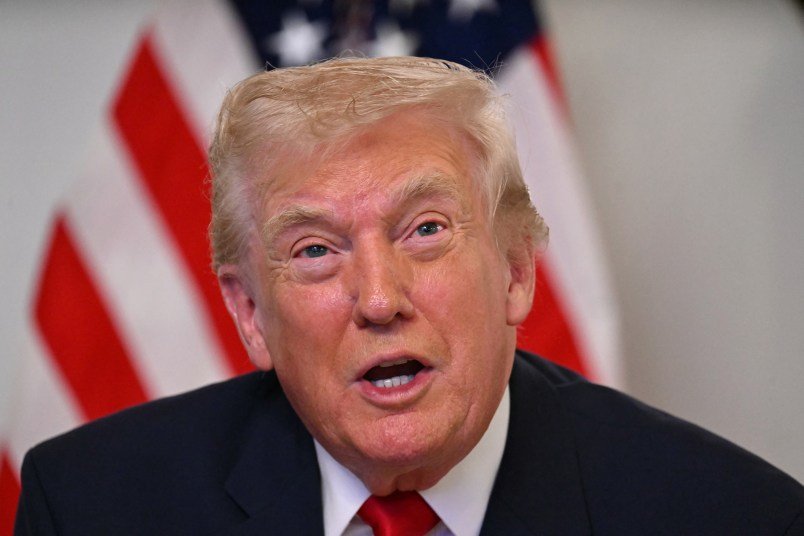
US President Donald Trump participates in a video call with military service members from his Mar-a-Lago residence in Palm Beach, Florida, on November 27, 2025, during the Thanksgiving holiday. US President Donald Tr...US President Donald Trump participates in a video call with military service members from his Mar-a-Lago residence in Palm Beach, Florida, on November 27, 2025, during the Thanksgiving holiday. US President Donald Trump said Thursday that Sarah Beckstrom, one of the two National Guard troops shot a day earlier near the White House, had died, while the other soldier was "fighting for his life." (Photo by Jim WATSON / AFP via Getty Images)MORE LESS
Indiana’s Republican-controlled state House approved a new gerrymandered congressional map on Friday, as expected.
Trump’s larger, nationwide gerrymandering blitz — which he has been pushing in red states for months now to try to ensure Republicans maintain control of the U.S. House in the 2026 midterm elections — appeared to be losing steam, making the fate of Indiana’s map especially important for the Trump administration.
Although the Supreme Court on Thursday put on hold a lower court ruling that blocked Texas’ gerrymandered map, other redistricting efforts in Republican-led states have faced challenges. Most recently, Republican plans for new, gerrymandered maps were shut down in both Utah and Kansas.
“I am glad to hear the Indiana House is stepping up to do the right thing, and I hope the Senate finds the Votes,” Trump wrote in a Truth Social post last month. “If they do, I will make sure that all of those people supporting me win their Primaries, and go on to Greatness but, if they don’t, I will partner with the incredibly powerful MAGA Grassroots Republicans to elect STRONG Republicans who are ready to do what is needed to protect our Country and, MAKE AMERICA GREAT AGAIN!”
Trump’s larger, nationwide gerrymandering blitz — which he has been pushing in red states for months now to try to ensure Republicans maintain control of the U.S. House in the 2026 midterm elections — appeared to be losing steam, making the fate of Indiana’s map especially important for the Trump administration.
Although the Supreme Court on Thursday put on hold a lower court ruling that blocked Texas’ gerrymandered map, other redistricting efforts in Republican-led states have faced challenges. Most recently, Republican plans for new, gerrymandered maps were shut down in both Utah and Kansas.
Amid uncertainty about whether there are votes for redistricting in the state Senate, Trump has continuously bullied Indiana Republicans into supporting his gerrymandering blitz in their state. He has also vowed to support primary challengers against anyone who is opposed to bringing his nationwide gerrymandering pressure campaign to Indiana.
“I am glad to hear the Indiana House is stepping up to do the right thing, and I hope the Senate finds the Votes,” Trump wrote in a Truth Social post last month. “If they do, I will make sure that all of those people supporting me win their Primaries, and go on to Greatness but, if they don’t, I will partner with the incredibly powerful MAGA Grassroots Republicans to elect STRONG Republicans who are ready to do what is needed to protect our Country and, MAKE AMERICA GREAT AGAIN!”
Trump’s larger, nationwide gerrymandering blitz — which he has been pushing in red states for months now to try to ensure Republicans maintain control of the U.S. House in the 2026 midterm elections — appeared to be losing steam, making the fate of Indiana’s map especially important for the Trump administration.
Although the Supreme Court on Thursday put on hold a lower court ruling that blocked Texas’ gerrymandered map, other redistricting efforts in Republican-led states have faced challenges. Most recently, Republican plans for new, gerrymandered maps were shut down in both Utah and Kansas.
“The issue of redrawing Indiana’s congressional maps mid-cycle has received a lot of attention and is causing strife here in our state. To resolve this issue, the Senate intends to reconvene as part of the regular 2026 session on Dec. 8 and make a final decision that week on any redistricting proposal sent from the House,” Bray said in a statement last week.
Amid uncertainty about whether there are votes for redistricting in the state Senate, Trump has continuously bullied Indiana Republicans into supporting his gerrymandering blitz in their state. He has also vowed to support primary challengers against anyone who is opposed to bringing his nationwide gerrymandering pressure campaign to Indiana.
“I am glad to hear the Indiana House is stepping up to do the right thing, and I hope the Senate finds the Votes,” Trump wrote in a Truth Social post last month. “If they do, I will make sure that all of those people supporting me win their Primaries, and go on to Greatness but, if they don’t, I will partner with the incredibly powerful MAGA Grassroots Republicans to elect STRONG Republicans who are ready to do what is needed to protect our Country and, MAKE AMERICA GREAT AGAIN!”
Trump’s larger, nationwide gerrymandering blitz — which he has been pushing in red states for months now to try to ensure Republicans maintain control of the U.S. House in the 2026 midterm elections — appeared to be losing steam, making the fate of Indiana’s map especially important for the Trump administration.
Although the Supreme Court on Thursday put on hold a lower court ruling that blocked Texas’ gerrymandered map, other redistricting efforts in Republican-led states have faced challenges. Most recently, Republican plans for new, gerrymandered maps were shut down in both Utah and Kansas.
Weeks later, however, Bray announced that Indiana lawmakers would convene early as part of their regular 2026 session in order to make a “final decision” on redistricting.
“The issue of redrawing Indiana’s congressional maps mid-cycle has received a lot of attention and is causing strife here in our state. To resolve this issue, the Senate intends to reconvene as part of the regular 2026 session on Dec. 8 and make a final decision that week on any redistricting proposal sent from the House,” Bray said in a statement last week.
Amid uncertainty about whether there are votes for redistricting in the state Senate, Trump has continuously bullied Indiana Republicans into supporting his gerrymandering blitz in their state. He has also vowed to support primary challengers against anyone who is opposed to bringing his nationwide gerrymandering pressure campaign to Indiana.
“I am glad to hear the Indiana House is stepping up to do the right thing, and I hope the Senate finds the Votes,” Trump wrote in a Truth Social post last month. “If they do, I will make sure that all of those people supporting me win their Primaries, and go on to Greatness but, if they don’t, I will partner with the incredibly powerful MAGA Grassroots Republicans to elect STRONG Republicans who are ready to do what is needed to protect our Country and, MAKE AMERICA GREAT AGAIN!”
Trump’s larger, nationwide gerrymandering blitz — which he has been pushing in red states for months now to try to ensure Republicans maintain control of the U.S. House in the 2026 midterm elections — appeared to be losing steam, making the fate of Indiana’s map especially important for the Trump administration.
Although the Supreme Court on Thursday put on hold a lower court ruling that blocked Texas’ gerrymandered map, other redistricting efforts in Republican-led states have faced challenges. Most recently, Republican plans for new, gerrymandered maps were shut down in both Utah and Kansas.
For weeks now, it has been uncertain whether the state Senate would convene for a special session on redistricting after Indiana Senate President Pro Tempore Rodric Bray last month announced that there were not sufficient votes within his conference to approve the gerrymandered maps.
Weeks later, however, Bray announced that Indiana lawmakers would convene early as part of their regular 2026 session in order to make a “final decision” on redistricting.
“The issue of redrawing Indiana’s congressional maps mid-cycle has received a lot of attention and is causing strife here in our state. To resolve this issue, the Senate intends to reconvene as part of the regular 2026 session on Dec. 8 and make a final decision that week on any redistricting proposal sent from the House,” Bray said in a statement last week.
Amid uncertainty about whether there are votes for redistricting in the state Senate, Trump has continuously bullied Indiana Republicans into supporting his gerrymandering blitz in their state. He has also vowed to support primary challengers against anyone who is opposed to bringing his nationwide gerrymandering pressure campaign to Indiana.
“I am glad to hear the Indiana House is stepping up to do the right thing, and I hope the Senate finds the Votes,” Trump wrote in a Truth Social post last month. “If they do, I will make sure that all of those people supporting me win their Primaries, and go on to Greatness but, if they don’t, I will partner with the incredibly powerful MAGA Grassroots Republicans to elect STRONG Republicans who are ready to do what is needed to protect our Country and, MAKE AMERICA GREAT AGAIN!”
Trump’s larger, nationwide gerrymandering blitz — which he has been pushing in red states for months now to try to ensure Republicans maintain control of the U.S. House in the 2026 midterm elections — appeared to be losing steam, making the fate of Indiana’s map especially important for the Trump administration.
Although the Supreme Court on Thursday put on hold a lower court ruling that blocked Texas’ gerrymandered map, other redistricting efforts in Republican-led states have faced challenges. Most recently, Republican plans for new, gerrymandered maps were shut down in both Utah and Kansas.
Despite mounting pressure and primary threats from President Trump, it remains unclear whether the Senate has enough votes to approve the new map.
For weeks now, it has been uncertain whether the state Senate would convene for a special session on redistricting after Indiana Senate President Pro Tempore Rodric Bray last month announced that there were not sufficient votes within his conference to approve the gerrymandered maps.
Weeks later, however, Bray announced that Indiana lawmakers would convene early as part of their regular 2026 session in order to make a “final decision” on redistricting.
“The issue of redrawing Indiana’s congressional maps mid-cycle has received a lot of attention and is causing strife here in our state. To resolve this issue, the Senate intends to reconvene as part of the regular 2026 session on Dec. 8 and make a final decision that week on any redistricting proposal sent from the House,” Bray said in a statement last week.
Amid uncertainty about whether there are votes for redistricting in the state Senate, Trump has continuously bullied Indiana Republicans into supporting his gerrymandering blitz in their state. He has also vowed to support primary challengers against anyone who is opposed to bringing his nationwide gerrymandering pressure campaign to Indiana.
“I am glad to hear the Indiana House is stepping up to do the right thing, and I hope the Senate finds the Votes,” Trump wrote in a Truth Social post last month. “If they do, I will make sure that all of those people supporting me win their Primaries, and go on to Greatness but, if they don’t, I will partner with the incredibly powerful MAGA Grassroots Republicans to elect STRONG Republicans who are ready to do what is needed to protect our Country and, MAKE AMERICA GREAT AGAIN!”
Trump’s larger, nationwide gerrymandering blitz — which he has been pushing in red states for months now to try to ensure Republicans maintain control of the U.S. House in the 2026 midterm elections — appeared to be losing steam, making the fate of Indiana’s map especially important for the Trump administration.
Although the Supreme Court on Thursday put on hold a lower court ruling that blocked Texas’ gerrymandered map, other redistricting efforts in Republican-led states have faced challenges. Most recently, Republican plans for new, gerrymandered maps were shut down in both Utah and Kansas.
The new map, which was unveiled on Monday, is designed in a way that it could flip two of the state’s congressional seats currently held by Democrats for Republicans in the upcoming midterms if it passes the state Senate later this month.
Despite mounting pressure and primary threats from President Trump, it remains unclear whether the Senate has enough votes to approve the new map.
For weeks now, it has been uncertain whether the state Senate would convene for a special session on redistricting after Indiana Senate President Pro Tempore Rodric Bray last month announced that there were not sufficient votes within his conference to approve the gerrymandered maps.
Weeks later, however, Bray announced that Indiana lawmakers would convene early as part of their regular 2026 session in order to make a “final decision” on redistricting.
“The issue of redrawing Indiana’s congressional maps mid-cycle has received a lot of attention and is causing strife here in our state. To resolve this issue, the Senate intends to reconvene as part of the regular 2026 session on Dec. 8 and make a final decision that week on any redistricting proposal sent from the House,” Bray said in a statement last week.
Amid uncertainty about whether there are votes for redistricting in the state Senate, Trump has continuously bullied Indiana Republicans into supporting his gerrymandering blitz in their state. He has also vowed to support primary challengers against anyone who is opposed to bringing his nationwide gerrymandering pressure campaign to Indiana.
“I am glad to hear the Indiana House is stepping up to do the right thing, and I hope the Senate finds the Votes,” Trump wrote in a Truth Social post last month. “If they do, I will make sure that all of those people supporting me win their Primaries, and go on to Greatness but, if they don’t, I will partner with the incredibly powerful MAGA Grassroots Republicans to elect STRONG Republicans who are ready to do what is needed to protect our Country and, MAKE AMERICA GREAT AGAIN!”
Trump’s larger, nationwide gerrymandering blitz — which he has been pushing in red states for months now to try to ensure Republicans maintain control of the U.S. House in the 2026 midterm elections — appeared to be losing steam, making the fate of Indiana’s map especially important for the Trump administration.
Although the Supreme Court on Thursday put on hold a lower court ruling that blocked Texas’ gerrymandered map, other redistricting efforts in Republican-led states have faced challenges. Most recently, Republican plans for new, gerrymandered maps were shut down in both Utah and Kansas.
The creator of the map legislation, Republican state Rep. Ben Smaltz, acknowledged during a House elections committee hearing on Tuesday that the maps are “politically gerrymandered,” but insisted that they were not racially gerrymandered.
The new map, which was unveiled on Monday, is designed in a way that it could flip two of the state’s congressional seats currently held by Democrats for Republicans in the upcoming midterms if it passes the state Senate later this month.
Despite mounting pressure and primary threats from President Trump, it remains unclear whether the Senate has enough votes to approve the new map.
For weeks now, it has been uncertain whether the state Senate would convene for a special session on redistricting after Indiana Senate President Pro Tempore Rodric Bray last month announced that there were not sufficient votes within his conference to approve the gerrymandered maps.
Weeks later, however, Bray announced that Indiana lawmakers would convene early as part of their regular 2026 session in order to make a “final decision” on redistricting.
“The issue of redrawing Indiana’s congressional maps mid-cycle has received a lot of attention and is causing strife here in our state. To resolve this issue, the Senate intends to reconvene as part of the regular 2026 session on Dec. 8 and make a final decision that week on any redistricting proposal sent from the House,” Bray said in a statement last week.
Amid uncertainty about whether there are votes for redistricting in the state Senate, Trump has continuously bullied Indiana Republicans into supporting his gerrymandering blitz in their state. He has also vowed to support primary challengers against anyone who is opposed to bringing his nationwide gerrymandering pressure campaign to Indiana.
“I am glad to hear the Indiana House is stepping up to do the right thing, and I hope the Senate finds the Votes,” Trump wrote in a Truth Social post last month. “If they do, I will make sure that all of those people supporting me win their Primaries, and go on to Greatness but, if they don’t, I will partner with the incredibly powerful MAGA Grassroots Republicans to elect STRONG Republicans who are ready to do what is needed to protect our Country and, MAKE AMERICA GREAT AGAIN!”
Trump’s larger, nationwide gerrymandering blitz — which he has been pushing in red states for months now to try to ensure Republicans maintain control of the U.S. House in the 2026 midterm elections — appeared to be losing steam, making the fate of Indiana’s map especially important for the Trump administration.
Although the Supreme Court on Thursday put on hold a lower court ruling that blocked Texas’ gerrymandered map, other redistricting efforts in Republican-led states have faced challenges. Most recently, Republican plans for new, gerrymandered maps were shut down in both Utah and Kansas.
While the new map had widespread support among Republicans in the state House — it passed by a 57-41 vote — the ultimate fate of the map remains unclear. The state Senate convenes on Monday, December 8 to make a decision on the matter.
The creator of the map legislation, Republican state Rep. Ben Smaltz, acknowledged during a House elections committee hearing on Tuesday that the maps are “politically gerrymandered,” but insisted that they were not racially gerrymandered.
The new map, which was unveiled on Monday, is designed in a way that it could flip two of the state’s congressional seats currently held by Democrats for Republicans in the upcoming midterms if it passes the state Senate later this month.
Despite mounting pressure and primary threats from President Trump, it remains unclear whether the Senate has enough votes to approve the new map.
For weeks now, it has been uncertain whether the state Senate would convene for a special session on redistricting after Indiana Senate President Pro Tempore Rodric Bray last month announced that there were not sufficient votes within his conference to approve the gerrymandered maps.
Weeks later, however, Bray announced that Indiana lawmakers would convene early as part of their regular 2026 session in order to make a “final decision” on redistricting.
“The issue of redrawing Indiana’s congressional maps mid-cycle has received a lot of attention and is causing strife here in our state. To resolve this issue, the Senate intends to reconvene as part of the regular 2026 session on Dec. 8 and make a final decision that week on any redistricting proposal sent from the House,” Bray said in a statement last week.
Amid uncertainty about whether there are votes for redistricting in the state Senate, Trump has continuously bullied Indiana Republicans into supporting his gerrymandering blitz in their state. He has also vowed to support primary challengers against anyone who is opposed to bringing his nationwide gerrymandering pressure campaign to Indiana.
“I am glad to hear the Indiana House is stepping up to do the right thing, and I hope the Senate finds the Votes,” Trump wrote in a Truth Social post last month. “If they do, I will make sure that all of those people supporting me win their Primaries, and go on to Greatness but, if they don’t, I will partner with the incredibly powerful MAGA Grassroots Republicans to elect STRONG Republicans who are ready to do what is needed to protect our Country and, MAKE AMERICA GREAT AGAIN!”
Trump’s larger, nationwide gerrymandering blitz — which he has been pushing in red states for months now to try to ensure Republicans maintain control of the U.S. House in the 2026 midterm elections — appeared to be losing steam, making the fate of Indiana’s map especially important for the Trump administration.
Although the Supreme Court on Thursday put on hold a lower court ruling that blocked Texas’ gerrymandered map, other redistricting efforts in Republican-led states have faced challenges. Most recently, Republican plans for new, gerrymandered maps were shut down in both Utah and Kansas.
While the new map had widespread support among Republicans in the state House — it passed by a 57-41 vote — the ultimate fate of the map remains unclear. The state Senate convenes on Monday, December 8 to make a decision on the matter.
The creator of the map legislation, Republican state Rep. Ben Smaltz, acknowledged during a House elections committee hearing on Tuesday that the maps are “politically gerrymandered,” but insisted that they were not racially gerrymandered.
The new map, which was unveiled on Monday, is designed in a way that it could flip two of the state’s congressional seats currently held by Democrats for Republicans in the upcoming midterms if it passes the state Senate later this month.
Despite mounting pressure and primary threats from President Trump, it remains unclear whether the Senate has enough votes to approve the new map.
For weeks now, it has been uncertain whether the state Senate would convene for a special session on redistricting after Indiana Senate President Pro Tempore Rodric Bray last month announced that there were not sufficient votes within his conference to approve the gerrymandered maps.
Weeks later, however, Bray announced that Indiana lawmakers would convene early as part of their regular 2026 session in order to make a “final decision” on redistricting.
“The issue of redrawing Indiana’s congressional maps mid-cycle has received a lot of attention and is causing strife here in our state. To resolve this issue, the Senate intends to reconvene as part of the regular 2026 session on Dec. 8 and make a final decision that week on any redistricting proposal sent from the House,” Bray said in a statement last week.
Amid uncertainty about whether there are votes for redistricting in the state Senate, Trump has continuously bullied Indiana Republicans into supporting his gerrymandering blitz in their state. He has also vowed to support primary challengers against anyone who is opposed to bringing his nationwide gerrymandering pressure campaign to Indiana.
“I am glad to hear the Indiana House is stepping up to do the right thing, and I hope the Senate finds the Votes,” Trump wrote in a Truth Social post last month. “If they do, I will make sure that all of those people supporting me win their Primaries, and go on to Greatness but, if they don’t, I will partner with the incredibly powerful MAGA Grassroots Republicans to elect STRONG Republicans who are ready to do what is needed to protect our Country and, MAKE AMERICA GREAT AGAIN!”
Trump’s larger, nationwide gerrymandering blitz — which he has been pushing in red states for months now to try to ensure Republicans maintain control of the U.S. House in the 2026 midterm elections — appeared to be losing steam, making the fate of Indiana’s map especially important for the Trump administration.
Although the Supreme Court on Thursday put on hold a lower court ruling that blocked Texas’ gerrymandered map, other redistricting efforts in Republican-led states have faced challenges. Most recently, Republican plans for new, gerrymandered maps were shut down in both Utah and Kansas.