


NASHVILLE, TENNESSEE–The Trump DOJ has spent the last several months constructing a narrowly focused narrative that then-acting U.S. Attorney Robert McGuire of Nashville was the sole decider in seeking a human smuggling indictment of Kilmar Abrego Garcia last May while he was still confined in El Salvador, a victim of a wrongful deportation in violation of a immigration judge’s order.
So it was no surprise that McGuire was the government’s own key witness today in defense of Abrego Garcia’s vindictive prosecution claim. And if you focused only on what was illuminated by the spotlight the government shone on McGuire, he was a compelling witness. He seemed earnest, well-intended, professional, and without guile. He was candid, didn’t get defensive, and was consistent throughout his testimony.
But the Trump DOJ, as hard as it tried, couldn’t keep some uncomfortable facts from sneaking into the glare of its spotlight on McGuire. And for anyone who knows the case well, the trick to seeing it clearly is to pan out from the administration’s narrow focus to see the broader context.
Within days of his wrongful removal to El Salvador in March 2025, the Trump administration, including the White House itself, launched a blistering smear campaign against Abrego Garcia, the thrust of which was to make a public case that he was a bad person who deserved his fate. As Abrego Garcia began winning in court — first in Maryland federal court, then at the 4th Circuit Court of Appeals, and finally at the Supreme Court — the government’s smear campaign against him intensified. It was during this time that DHS dredged up information about a 2022 traffic stop, featuring it in its effort to defend its mishandling of his deportation.
The timeline is striking:
March 15, 2025: Abrego Garcia is deported to El Salvador
April 1, 2025: Homeland Security Investigations closes human trafficking investigation on Abrego Garcia.
April 4, 2025: Maryland federal judge orders the administration to “facilitate” Abrego Garcia’s return
April 7, 2025: Appeals court upholds the decision
April 10, 2025: Supreme Court upholds the decision
April 17, 2025: HSI reopens its investigation
May 21, 2025: Abrego Garcia is indicted
For the Trump DOJ, the most uncomfortable fact to intrude on its narrative in today’s testimony in front of U.S. District Judge Waverly D. Crenshaw Jr. of Nashville was that Associate Deputy Attorney General Aakash Singh already knew more about the criminal investigation of Abrego Garcia than McGuire did when they first discussed the case.
McGuire recounted getting a unusual Sunday afternoon or evening phone call last April 27 from Rana Saoud, the special agent in charge of the Nashville HSI office, alerting him to the late 2022 I-40 traffic stop of Abrego Garcia, years before he became a poster boy for the arbitrary, capricious, and inept nature of Trump mass deportation operation.
Within a few hours of that call, McGuire received an email from Singh.
“I knew instantly what the email was about,” McGuire testified.
The subject line of the email referred to a man who would become a chief witness against Abrego Garcia and as allegedly involved in the human smuggling operation with him; the SUV that Abrego Garcia was driving when he was stopped by the Tennessee Highway Patrol was registered to him. In addition to McGuire, the other recipients of the email were the U.S. attorney in Alabama where the man was imprisoned and the U.S. attorney in Texas where he had been convicted.
On cross examination, McGuire was pressed on the fact that Singh knew about this witness before he did. “Lots of people knew about this witness before I knew about this witness,” McGuire conceded.
Singh’s email, which arranged for a call the following day with him and the three U.S. attorneys, showed that Singh was already on the case and coordinating the investigation that McGuire, who had just learned of the traffic stop, would ostensibly lead. McGuire testified that he would come to learn that a second witness had emerged shortly before he got involved in the case, a woman who claimed to have been involved in the human smuggling operation in 2018-19 and could place Abrego Garcia in it.
Much of McGuire’s testimony was focused on walking through various email exchanges involving him and Singh and other investigators from late April up until the May 21 indictment that were largely unhelpful to the government. Woodward’s task was to detonate these grenades on direct before Abrego Garcia’s attorneys could do damage with them on cross examination. They included emails from Singh saying things like “Keep me posted,” “How close are we to charging?” and “ Do we have a sense of potential charges?”
McGuire cast those emails as normal oversight from the Office of the Deputy Attorney General, noting his own responsibility as outlined in the DOJ’s Justice Manual to keep the deputy attorney general informed. One email from Singh right before the indictment directed McGuire and other recipients, “Let’s keep a close hold until we get clearance.” Abrego Garcia’s lawyers would zero in on who was giving approval to proceed with the indictment. McGuire testified that he wasn’t sure what Singh meant by that because “we weren’t asking for permission.”
Saoud, who has since retired from HSI, was the only other government witness in today’s hearing. She testified that she first learned of the 2022 traffic stop from the Tennessee Star, a conservative news outlet which posted about it on April 16. She couldn’t remember who showed the article to her, testifying that it was either a friend or co-worker.
After learning of the traffic stop, Saoud first called the Tennessee Highway Patrol and then McGuire directly because of the high-profile nature of the case, Saoud testified. Then, she said, she called her direct supervisor, at HSI headquarters in DC, and told him she was looking into it “given the notoriety of the individual involved.” She cast it as a bureaucratic heads up. “We’re not swayed by public attention or political considerations in deciding whether to investigate,” she said.
Yet, the notoriety of Abrego Garcia was a recurring theme in the testimony of Saoud and McGuire. Over and over, they confirmed that Abrego Garcia’s case was handled differently because he had such a high public profile. In bureaucratic terms, it makes sense. No one wants to be blindsided by a controversial case. But it wasn’t helpful to the government case that Abrego Garcia was treated differently.
McGuire decided to handle the case personally rather than delegate it to someone in his office. “I knew it was going to be controversial,” he testified. “I’d rather it be me than someone else.”
He even anticipated that he would be in court one day defending a vindictive prosecution claim, like he was today, and didn’t want to put that burden on an underling. The traffic stop was more than two years old, so the question would be “Why now?” McGuire testified. “I acted on it as soon as I learned about it, but I couldn’t change when I learned about it.”
This goes to a core dynamic of the case: Abrego Garcia wasn’t notorious because of the crimes he’d been accused of. He was notorious for being a victim of the Trump administration, which refused to admit its mistake in deporting him and tried to save face by continually upping the ante and defying court orders in a confrontation with the judiciary.
The subtext of McGuire’s testimony was that everyone involved at every level of government knew the implications of a criminal prosecution of Abrego Garcia. Everyone knew what “side” the administration was on. They didn’t have to be told explicitly what to do or be given direct orders. Abrego Garcia was a thorn in the side of the Trump administration, and everyone knew that.
McGuire’s defense, which is fair as far as it goes, is that he would never have brought the criminal case against Abrego Garcia if the facts didn’t support it. He also convincingly testified that he would have refused to prosecute if the facts didn’t support it. “I wasn’t going to charge something I didn’t believe in,” he said. But that largely sidesteps the larger point that HSI raced to reopen the investigation, senior leaders like Saoud and McGuire quickly moved to investigate, and an indictment was swiftly returned.
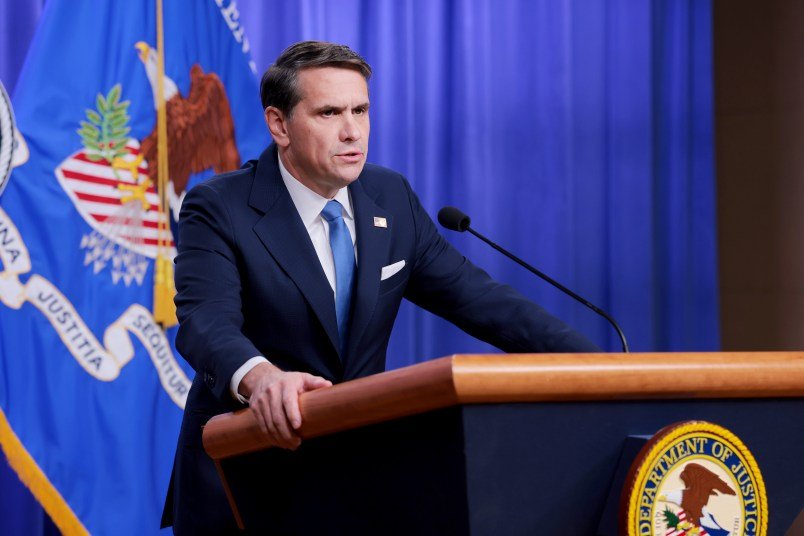
The Trump DOJ’s unusual handling of the case was further betrayed by who served as its lead lawyer defending the vindictive prosecution claim: Associate Attorney General Stan Woodward, the No. 3 at DOJ, who personally handled McGuire’s direct testimony today.
Woodward started by cutting straight to the chase, securing testimony from McGuire that he and he alone made the decision to seek an indictment and was not directed, instructed, or pressured to do so by Deputy Attorney General Todd Blanche or anyone else at DOJ, DHS, or the White House. McGuire was all alone in Woodward’s spotlight.
Yet, in one internal DOJ email, McGuire wrote that he’d learned that Blanche and then-principal Associate Deputy Attorney General Emil Bove wanted Abrego Garcia charged sooner than later. On the stand, McGuire couldn’t recall who had told him that.
The burden was on the Trump DOJ today. Their task was to shift it back to Abrego Garcia. If they failed, Abrego Garcia wins. If they succeeded, Judge Crenshaw has said he’ll consider whether to let Abrego Garcia conduct more discovery and call senior DOJ leaders, including Blanche and Singh, to testify
At the conclusion of the hearing, Judge Crenshaw asked for more briefing from the two sides and suggested he might want oral arguments as well. Crenshaw asked a few questions of witnesses but he didn’t tip his hand.