
President Trump won a key victory on Friday in a case that tested his efforts to stage explicitly political terrorism prosecutions of activists who oppose him.
A Texas jury found eight members of a supposed North Texas “Antifa cell” guilty of material support for terrorism over a July incident in which the group staged a demonstration outside an ICE detention facility. The group allegedly damaged property at the center and shot fireworks; one member, Ben Song, was convicted of attempted murder of a government official for allegedly shooting a police officer.
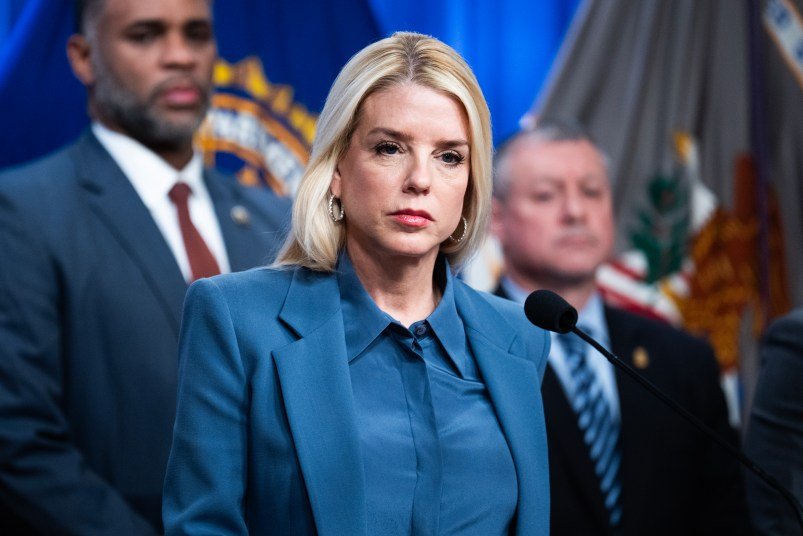
The case was the first time that the Trump DOJ brought terrorism charges against what it labeled as “Antifa,” the ill-defined array of antifascist beliefs that the administration has deemed a national security threat. Attorney General Pam Bondi made the point of the “Antifa” label clear in a statement reacting to the verdicts: it’s about pursuing aggressive charges against the opposition.
“Antifa is a domestic terrorist organization that has been allowed to flourish in Democrat-led cities — not under President Trump,” Bondi said. “Today’s verdict on terrorism charges will not be the last as the Trump administration systematically dismantles Antifa and finally halts their violence on America’s streets.”
The case began as a prosecution over the shooting of the officer and damage to government property, search warrants obtained by TPM show.
But in September, the Trump administration began to prod federal law enforcement to investigate and charge activists that opposed it, citing Charlie Kirk’s killing as a justification. In a memo, NSPM-7, the White House directed federal law enforcement to treat ideologies like “anti-Americanism, anti-capitalism, and anti-Christianity” as indicia of “domestic terrorism.” Trump also designated Antifa a “domestic terrorist organization,” a move that has no basis in American law but still provided a signal to federal law enforcement to prioritize those who might fit into a definition of “Antifa.”
Weeks later, federal prosecutors in Texas upgraded the charges to material support for terrorism. It’s a rare use of the statute, which was pioneered after 9/11 to go after audacious international and domestic terrorism plots.
The Trump administration used the case as part of its national efforts to suggest that ICE agents were under attack by “Antifa” and “domestic terrorists.” Bondi cited the incident in a December memo directing federal law enforcement to pursue those the White House deems “domestic terrorists.”
But throughout, the government has struggled to define what it means by “Antifa.” At trial, federal prosecutors called Kyle Shideler to help explain. Shideler is a longtime employee of the Center for Security Policy, designated by the Southern Poverty Law Center as a hate group. Before Shideler began to present himself as an expert on “Antifa,” he cast himself as an authority on Islamic extremism and the terrorist threat it supposedly posed. Shideler said at trial that prosecutors used the definition of “Antifa” that he provided in the indictment.
The prosecution came in for criticism in part over the tenuous links some defendants had to the core charges, which stemmed from property damage to the ICE facility and the shooting of the police officer. Some defendants were not alleged to have been part of chats used to plan the demonstration; prosecutors tied others to the incident by alleging that they created “insurrectionary materials called ‘zines.’”
U.S. District Judge Mark Pittman for the Northern District of Texas, an appointee from Trump’s first term, tried the case. Pittman initially declared a mistrial after a defense attorney questioned jurors while wearing a shirt under her jacket that had the faces of civil rights leaders. (Jesse Jackson, one figure in that movement, had died that morning.) Several jurors that day reportedly expressed skepticism over ICE’s activities; Pittman conducted juror questioning himself on the second go around.
After a 12-day trial, a federal jury found eight of the defendants guilty on material support of terrorism. Those eight were also found guilty on charges of riot, and conspiracy to use an explosive. Song, the alleged shooter, was found guilty of discharging a firearm during a crime of violence and attempted murder of an officer of the United States. Two defendants were found guilty of corruptly concealing a document and conspiracy to conceal.
Four others charged with attempted murder were acquitted of those counts. The jury acquitted Song of two additional attempted murder counts.