
Sky York Journal
This story was originally reported by Brooke Migdon of The 19th. Meet Brooke and read more of their reporting on gender, politics and policy.
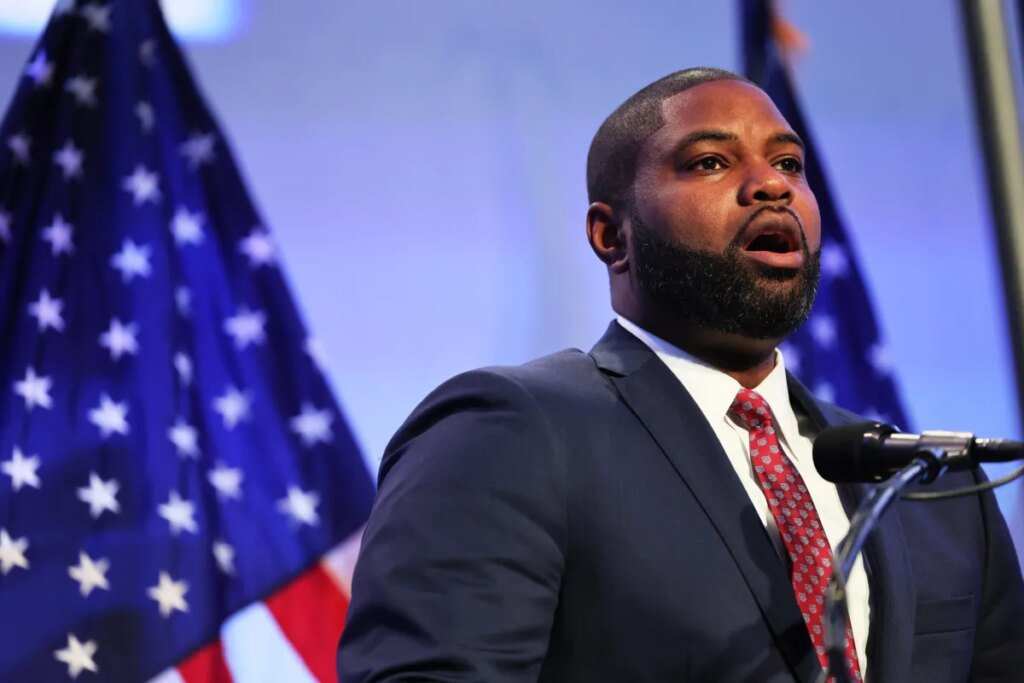
Speaking to a crowd of supporters in central Florida in August, U.S. Rep. Byron Donalds denounced his soon-to-be general election opponent for governor, Democrat David Jolly, as a “Trojan horse” for progressive politics in the reliably red state.
“David Jolly is somebody who thinks it’s still OK for boys to be in girls’ sports,” said Donalds, purposefully misgendering transgender girls. “Just pure insanity.” A day later, he secured the Republican nomination.
In a Facebook post earlier that week, the Republican Party of Florida had claimed “boys WILL be allowed to compete in girls’ sports” if Jolly, a former Republican congressman who has objected to sweeping state bans on trans student-athletes, is elected in November. The group shared a video of an AI-generated brawny, masculine figure in a women’s bathing suit smirking on a winner’s podium, strutting through a women’s locker room and ripping open a shower curtain.
“Will I have to race someone like that one day?” a young girl asks in the video. “David Jolly says we have to let them play,” her mother replies.
But Jolly, who secured the Democratic nomination for governor last month, would not have the authority to do so: Florida law has prohibited trans student-athletes from joining sports teams that match their gender identity for more than five years. Jolly has said he has “no plans” to change the current law.
In Georgia’s competitive governor’s race, Republican healthcare executive Rick Jackson has launched nearly identical attacks against his Democratic opponent, Keisha Lance Bottoms, the former mayor of Atlanta.
“Keisha Lance Bottoms thinks boys should play girls’ sports. That’s just crazy,” Jackson wrote on his campaign’s official Facebook page in April. He reiterated his criticism of Bottoms in another social media post in June, writing that his opponent “has no problem with boys playing girls’ sports,” and denouncing her position that athletic governing bodies, rather than politicians, should set eligibility requirements.
But Georgia, too, has long banned trans students from teams matching their gender identity.
The Georgia High School Association, which oversees high school sports in the state, voted unanimously in 2022 to designate sports teams based on students’ sex assigned at birth, and legislation signed by Republican Gov. Brian Kemp last spring prohibits trans athletes from competing on teams that match their gender identity from kindergarten through college. (Nationally, the NCAA has barred trans women from competing in women’s collegiate sports since February 2025.)
In governors races across the country, Republican candidates have rallied against inclusive sports policies — even in states where limitations on trans athletes have been in place for years.
Claims that Democrats support allowing trans athletes to compete flew during a recent gubernatorial debate in Kansas, where trans girls have been barred from competing in girls’ and women’s sports since 2023. Candidates’ positions on trans athletes have even emerged as a talking point in the race for Indiana secretary of state — a position with no lawmaking ability in a state where trans students have been prohibited from competing in line with their gender identity since 2022.
In June, after narrowly clinching the Republican nomination for governor of Iowa, private school founder Zach Lahn claimed Democrat Rob Sand would be “willing” to allow trans student-athletes to join teams matching their gender identity, despite a state law that has prohibited them from doing so since 2022.
Some Democrats have recently voiced support for restrictions on trans athletes, but “it’s Republicans that are bringing it up,” said Lanae Erickson, senior vice president at Third Way, a centrist Democratic advocacy group and think tank. “Republicans don’t have much else to run on. They’re not going to run on the economy, and the dynamics on immigration, politically, have shifted. So, this is kind of their last bet, and they are playing it literally everywhere.”
Sand, Iowa’s state auditor since 2019, has said in interviews that he does not support allowing trans students to compete in line with their gender identity. In Ohio, Democrat Amy Acton drew outrage and disappointment from LGBTQ+ groups over the summer when she told a local newspaper that she would “not support boys playing in girls’ sports” as governor, citing a 2024 state law that already bars trans women and girls from K-12 and collegiate sports.
The landscape for transgender students in sports has shifted dramatically in just a short time: Idaho, the first to enact explicit statewide restrictions on trans athletes, did so only in 2021. More than half the nation has since adopted similar restrictions, and President Donald Trump has made barring trans women and girls from female sports nationally a central policy focus of his second administration.
State and federal lawsuits against both restrictive and inclusive policies have yielded mixed results. In June, the Supreme Court ruled that states can lawfully bar trans student-athletes from competing in line with their gender identity.
But voters in states with restrictive laws may not be entirely aware of those policies, experts said, and candidates are cashing in on the confusion.
“People feel that the status quo is very chaotic, and they don’t know what their state’s rules are,” said Erikson. “They see media coverage of an instance of a transgender person competing somewhere in America, and they don’t really think about whether that is in Ohio or in Iowa.”
Campaigns have very little incentive to correct the record, said Andrew Flores, an associate professor of government at American University. “They’re trying to be persuasive,” he said. “They’re not trying to be fact-oriented.”
Other voters may know their state’s policies but prioritize national politics.
“Given our media environment, people are thinking far less about what’s going on locally than what’s going on nationally,” Flores said. “As long as people are convinced that this is still a national issue, as opposed to a local issue, then campaigns can still try and run on the issue even if, technically, it’s a non-issue in their district or state.”
Nationally, Republican-aligned groups are betting big on anti-trans messaging ahead of November’s midterms, seeking to capitalize on public opinion polls that show most Americans favor separating sports teams by sex assigned at birth.
More than three dozen ads released since the beginning of September by America PAC, the super PAC created and funded by Elon Musk, for instance, hammer Democrats over the party’s once-broad support for trans rights, including when it comes to sports. Musk, the world’s richest person, plans to spend at least $100 million to help elect Republicans this fall, the New York Times reported in July.
“Republican politicians are banking on the fact that the majority of Americans may not know that they know a trans person, or may not know anything about what it means to be trans,” said Zein Murib, an associate professor of political science at Fordham University. “They have an opportunity to set the agenda, or at the very least exploit that lack of knowledge about trans people.”