
Sky York Journal
When Linda and I spoke in October, her GPS ankle monitor was giving her constant electrical shocks. “It’s crazy, my leg is numb,” she said. When she tried to message Immigration and Customs Enforcement about the problem, she received no answer. She planned to go to her local ICE office later that day to get it fixed — the fourth time, she said, that she had to seek such help with a malfunctioning monitor since she had started wearing one four months earlier.
In July, Linda — a pseudonym because she still has an open immigration case — flew from New York to Hawaii for work. When the 35-year-old arrived at her gate for her flight back home, ICE officers were waiting and detained her. She came to the U.S. eight years ago on a visa and overstayed, but she has no criminal record. She’s had nightmares of flying somewhere and realizing she didn’t have the necessary documents to get back home. Now her worst nightmare was coming true.
She was held in a Hawaii jail for a month. She already struggles with mental health issues; she worried she would harm herself while detained. Eventually, she was able to get a bond hearing, where she was told she had to pay $10,000 to be released, far higher than what she could cover on her own. She was able to connect with Envision Freedom Fund, a bond fund, which posted bond for her, and she was released. In theory, bond is meant to ensure someone returns to immigration court and doesn’t flee since that’s the only way to get the money back. But immediately after Linda left the jail she was brought to another room, she said, where she was also forced to put on the ankle monitor.
GPS monitoring of immigrants isn’t new; its use doubled under President Joe Biden’s watch. But before the second Donald Trump administration, it was more often used in the place of detention. “It was uncommon for someone to be released on bond and put on some kind of physical technological surveillance because it was seen as redundant,” said Elizabeth Nguyen, program director at the Community Justice Exchange, a network of bail and bond funds. If someone was able to pay bond and get released from immigration detention, they were usually able to continue living their lives as normal. “It was just not something that we were seeing before,” said Rosa Santana, co-executive director of Envision Freedom Fund.
Now it’s extremely common for immigrants to be released from detention, only to be forced to wear an ankle monitor. Even getting released has become far more difficult as the Trump administration has fought against people’s ability to get a bond hearing and, in the rarer and rarer instances where people are granted bond, the amounts they have to pay have dramatically increased. Those lucky few who are granted bond face the new hurdle of GPS monitoring. The increase in the tactic appears to have occurred after the Trump administration issued a memo in June 2025 instructing ICE Enforcement and Removal Operations employees to, for all immigrants not being detained, “escalate their supervision level to GPS ankle monitors whenever possible.” After Trump revoked Temporary Protected Status for Haitians, many were called into ICE offices and made to wear ankle monitors.
He didn’t want anyone at his job installing windows to know, so he bought baggy pants and boots to fit over it and walked differently so his coworkers wouldn’t see it. When he was suspended at high heights, he had to be extra careful not to let it bang loudly against the ladder or the building.
The effects were deadly for at least one immigrant. On August 31, Pierre Damas Bel, a 20-year-old Haitian immigrant, died by suicide after being made to wear an ankle monitor, walking into oncoming highway traffic in Springfield, Ohio. His family have said that the mental toll of the monitor led to his death. Co-captain of a soccer team, he had pleaded with ICE to let him take it off because he couldn’t play in it; in his Reserve Officers’ Training Corp class, everyone was handed a uniform except for him. His classmates bullied him over it. “I’m walking through the streets of the United States with a GPS monitor on my leg, carrying a feeling of shame and humiliation that I never imagined I would experience,” he wrote in an Instagram post before his death.
According to a report by Envision, nearly 54,000 immigrants were wearing these monitors by July 2026, more than three times as many as at the start of 2025. Santana estimated that 98 percent of the people the fund pays bond for have come out wearing an ankle monitor or are made to put one on in the days after their release. “It’s almost everybody,” she said.
Miguel had never in his life been incarcerated before last year; after he entered the United States at the southern border, he was “viviendo normal,” living normally, in New York City and never had any legal problems. But then he went to a regular ICE check in at 26 Federal Plaza in lower Manhattan and was detained, spending two months in jail, most of it at the Metropolitan Detention Center in Brooklyn. “Fue bastante tortuosa,” he said: it was quite tortuous. He was elated when he was released on bond.
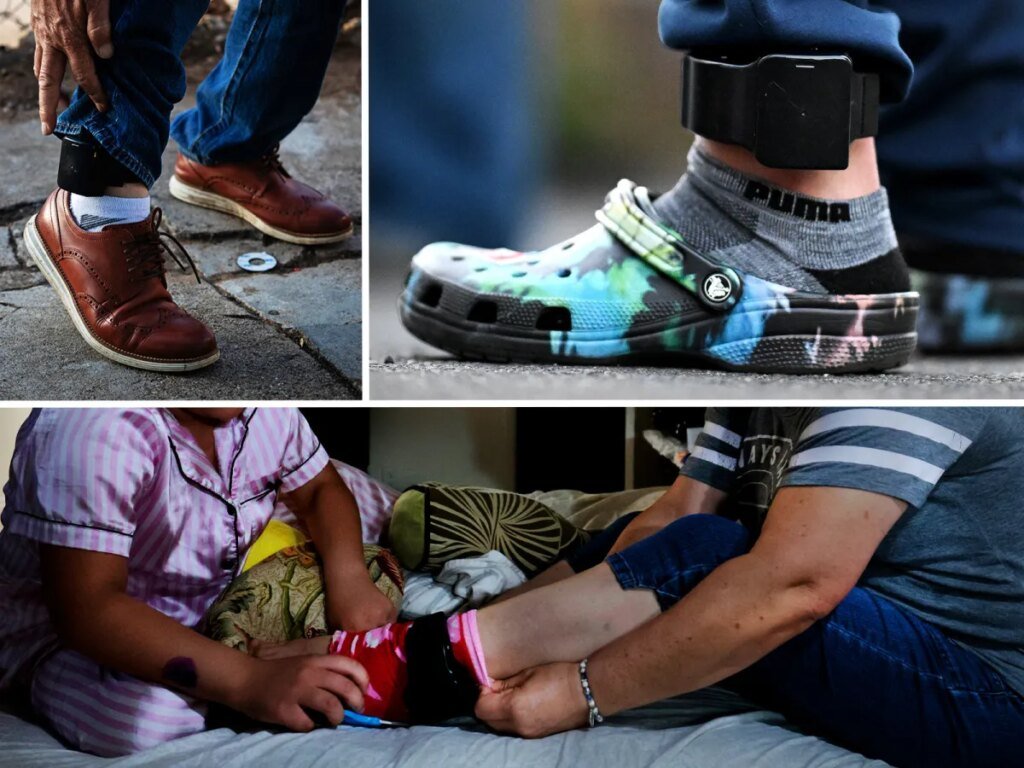
But before he was allowed to go, he was brought back to 26 Federal Plaza, where agents put an ankle monitor on him. He accepted it, he said, because his other choices were going back to jail or being deported. He ended up wearing the monitor for ten months, and it changed everything, he said. He didn’t want anyone at his job installing windows to know, so he bought baggy pants and boots to fit over it and walked differently so his coworkers wouldn’t see it. When he was suspended at high heights, he had to be extra careful not to let it bang loudly against the ladder or the building. The charge on his device only lasted four hours, and when it ran out it made a loud noise, so he had to find a way to discretely charge it during the workday.
It also changed his personal life. “Es bastante pesado,” he noted: it’s very heavy, so he had to adjust the way he slept, lying on his side and dangling his foot over the bed so it wouldn’t hit the rest of his body and wake him up. Even today, months after the monitor was taken off, he still feels it, akin to a phantom limb. But worse than the physical discomfort was the mental toll. “Sentía mucha rabia, mucha impotencia,” he said: I felt a lot of rage, a lot of impotence. He saw it every morning when he woke up, and it reminded him of the story of the elephants and the post: although the giant, strong creatures are only tied with a thin rope, they can’t get free.
This phenomenon is not just happening in New York. The majority of people whose bond is paid through members of the Community Justice Exchange have ended up on GPS surveillance, either through an ankle monitor, watch, or phone app. “We’re seeing it everywhere,” Nguyen said. Her organization has also seen cases of people who were detained but won their cases for asylum and were released, only to be put on GPS monitors.
Julia Zalenski, co-founder of the bail and bond fund Prairielands Freedom Fund in Iowa, has seen an increase in GPS monitoring for people who have been released from immigration detention. “It’s very common right now for us to post bond for someone, then have them immediately receive a notice to appear to be put on ATD [Alternatives to Detention] monitoring,” she said by email. “In some places it’s certainly more common than not, and a few locations seem to try and put everyone who is released from detention on ATD.”
This monitoring is a huge burden on people. The batteries have to be charged for at least two hours a day; if not, they start beeping and result in immediate calls from ICE. They cut and irritate people’s skin. It’s hard to wear work boots with the monitors, making it difficult for some people to do their jobs. Many can’t exercise with one on. “It’s also the stigma,” Santana noted. Some people have family members who don’t want them to stay with them if they’re wearing a monitor out of fear of being in ICE’s spotlight.
People forced to wear ankle monitors also have to not only check in at ICE offices regularly but, as a new addition, have ICE officers visit their homes to make sure they haven’t left and are abiding by requirements. There’s “the additional harm of, then ICE knows exactly where you are at any point in time,” Nguyen said. “Folks unfortunately are just trapped and totally ensnared in the detention and deportation machine.”
“It is just a continuation of being locked up,” Santana said. “It’s hard for people to disconnect, ‘Okay I am really free,’ when you are being monitored 24 hours a day, seven days a week.”
Through tears, in October Linda described avoiding her beloved local library, where she used to go weekly, because it has metal detectors at the doors that would be set off by her monitor. “It’s so shameful because people don’t understand,” she said. “People look at me and judge me, and I’m avoiding that.” She likes to run, but she had given that up because it had become impossible. She hadn’t been going on any dates. She loves concerts, but she had to check ahead of time to see if the venue had a metal detector; when she recently went to a ballet at Lincoln Center, she had to walk through one and kept wondering what the security staff were thinking. “The things that I used to do for leisure, it’s just like I can’t,” she said. “It stops me from doing the stuff that I used to like.” She was grateful for the onset of colder weather, making it easier for her to wear pants that covered the monitor.
There were physical repercussions, too. The monitor was heavy, and she noticed that she’d been walking differently to compensate for it. She struggled to sleep with it and worried it would start beeping due to a low charge during the night. She was constantly getting blisters from it — living in New York, she walks a lot.
Keeping the battery charged was also an extra burden. There was no indicator telling her how fully charged it was, and if it got drained a loud voice repeated “low battery” until she could swap it out and charge it again. If it got fully drained, she could expect a call from ICE or even a knock on her door. It was too uncomfortable to charge it while she slept, so she charged it in the mornings before work, hoping it would last through the whole day.
It wasn’t the only way she was being monitored, either. Every eight weeks she had to check in at an ICE office. ICE officers also came to her home every eight weeks, forcing her to stay in her apartment from 6am to 6pm, waiting for them to show up.
“I’m not a criminal,” she said. “If I was, at least it’s like, okay, I did something and I’m paying the price for it.” But she noted that she decided to stay in the U.S. because it was her lifelong dream to live in New York, she wanted to get a chance at a better life, and she works, pays her taxes. “I’m not doing any harm to anybody.”
But she knew that wasn’t the point. The point was to wear her down. “They do it so eventually someone will give up,” she said.
In early November, she finally got some relief: she requested that, because she had worn the monitor for 90 days and it kept shocking her, it be removed, and her request was granted. She was switched to being monitored by an app on her phone, along with regular ICE check-ins. She finally contemplated being able to go to the library, to a concert, on a run, on a date. But more important than that is “the peace of mind of not having to charge it, not stressing about [it] making noises in public, no more anxiety,” she said. “That’s such a relief.”