
Sky York Journal
Mississippi Democratic Senate candidate Scott Colom this week flipped Forrest County. Named for the founder of the Ku Klux Klan, Nathan Bedford Forrest, the area is steeped in the history of racial repression, and of the Civil Rights Movement.
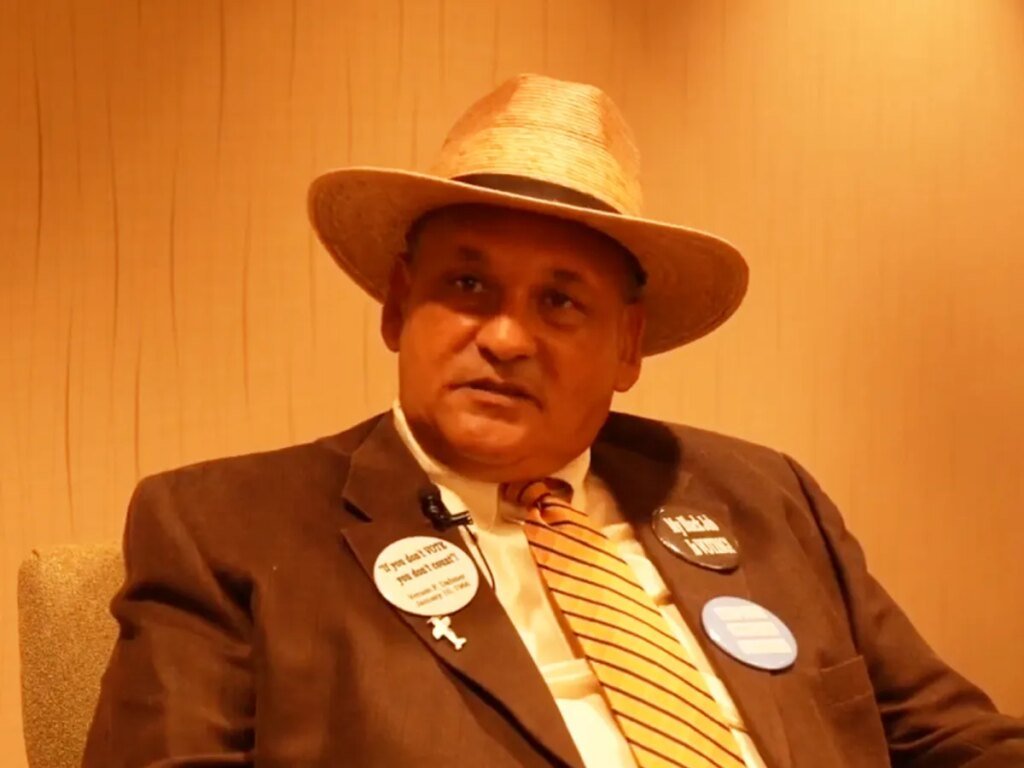
Dennis Dahmer, who grew up in Forrest County and resides there now, is a living encapsulation of that history. In 1966, when he was 12, a group of Klansmen assaulted his family home outside of Hattiesburg, Forrest County’s seat. They had come for Dahmer’s father, Vernon. An influential figure in the local African-American community, Vernon served as president of the Forrest County NAACP and would pay poll taxes for Black voters at his shop. He remained steadfast when members of the local White Citizens’ Council warned him to stop. After he recorded a radio announcement offering to cover poll tax costs, a group of armed Klansmen opened fire on the Dahmer home the next day and set it ablaze.
Dennis remembers watching his father die of smoke inhalation from the attack. He was left with a life defined in part by his father’s sacrifice, and with an unshakeable motivation to stay involved in politics. He recalled to TPM in a conversation on Tuesday his father’s motto, now inscribed on a statue in Hattiesburg, Mississippi: “If you don’t vote, you don’t count.”
For Dahmer and other relatives of Civil Rights Movement martyrs, Colom’s likely victory over incumbent Sen. Cindy Hyde-Smith (R-MS) represents more than a change in partisan identity. It’s something closer to a bending of the arc of history — that even after decades of suppression, sometimes subtle and sometimes violent, the ballot box can allow people from discriminated communities to represent, and maybe change, the state that oppressed them.
“It just further validates the work that they did,” Dahmer said.
Colom brought episodes from Mississippi’s often-violent history in the Civil Rights Movement into his campaign. He ended his campaign at the home of Medgar Evers, a civil rights activist who was also assassinated while at home. One ad showed Colom walking through Evers’ home.
“It’s a powerful reminder of the sacrifice to gain the ballot, and nobody sacrificed more than Medgar Evers and his family,” Colom said of the ad on Friday.
“What was important to me about that ad is we didn’t ask people to vote for me. We just talked about the sacrifice, talked about the story,” he added. “We just wanted that to be the closing ad because I wanted that to be the last message that the people of Mississippi heard.”
Colom, if he wins, will be Mississippi’s first Black Senator since Blanche Bruce during Reconstruction. Bruce’s term ended in 1881. Since then, the state has been dominated by white politicians, first Jim Crow-supporting Democrats, then, more recently, Republicans.
The 1965 Voting Rights Act, which preceded Dahmer’s killing by several months, brought an end to the Jim Crow tactics that his family had fought in Forrest County: poll taxes, poll tests, any means to block Black people from voting. Dahmer and other relatives of murdered Civil Rights activists saw the Supreme Court’s 2026 Callais decision, which rolled back much of what remained of the VRA, as a new injustice.
Dahmer can reel off statistics about Mississippi politics by heart, naming the African American and Democratic candidates who tried and failed to win statewide races before Colom. And yet, he can’t quite bring himself to believe that Colom will really win. In a conversation on Tuesday, he put Colom’s odds of winning at 75 percent, adding that many Democrats in Mississippi and elsewhere have long “had a defeatist attitude” about the state.
Older Mississippians, he said, “have a direct memory of what segregation was about, and of when Black folks couldn’t vote.”
Callais, and the aggression with which state legislators pursued redistricting after the decision came down, played a big role in spurring those voters and others to the polls, he said. In the south, where partisanship almost always equals race, that sent an obvious message.
“All you gotta do is look around and you’ll see how district lines are being redrawn,” he said, adding that other recent high-profile cases, like the unsolved murder of Nolan Wells, had played a role in motivating people to vote.
Colom leads Hyde-Smith by around 2,500 votes, current tallies show. The state has a deadline to certify the race by Friday. Both parties have sent battalions of lawyers to the state. Mississippi has no recount law; a court case over the vote could prolong the certification process.
For Dahmer, it’s a reminder of the movement for which his father gave his life, and whose spirit he saw last week.
“That’s what it was all about, having political power to change the lives of people,” he said.