
Sky York Journal
Virtually every Democrat in Montana can agree on two things: Republican Senator Steve Daines outfoxed them, and the left fumbled a winnable Senate seat.
“S squared,” former Montana Gov. Brian Schweitzer (D) summarized to TPM. “Shitshow.”
On that assessment, Democrats are unanimous. It’s the “why” and “how” and “whose fault is it” where opinions start to diverge.
While the country was awash in a blue tsunami, Montana — a state that’s sent a Democrat to the Senate a whole lot more recently than, say, Mississippi or Kansas — elected Daines’ hand-picked successor, Kurt Alme, with 48 percent of the vote. Democrat Alani Bankhead (12 percent) and independent Seth Bodnar (38 percent) split the remainder, which together totals about 50 percent. It’s unpleasant math for Montana Democrats to swallow while their peers elsewhere are still popping champagne.
“Speculation is always dangerous. I mean I think you look at the numbers,” Bodnar told TPM when asked if he thinks he would have won if Bankhead dropped out. “And what I do know is, add those up and I think it’s a tossup of a race. At least it’s a tossup — I think we’ve got a very very good shot at winning.”
So what happened? How could a problem everyone knew about as far back as the filing deadline in March — and definitely since the primaries in June — go unfixed for a whole campaign? Why did neither Bankhead nor Bodnar drop out, ensuring that the field would be split and Alme gifted the seat? How was this allowed to happen?
TPM spoke to over a dozen people close to the race, including both Bodnar and Bankhead, to find out.
Daines’ Dirty Trick
It all starts with Daines — and his “maneuver” or “killer instinct” or “trickery” or “bad sportsmanship” or “shenanigans” or “backroom dealing,” depending on who’s telling the story.
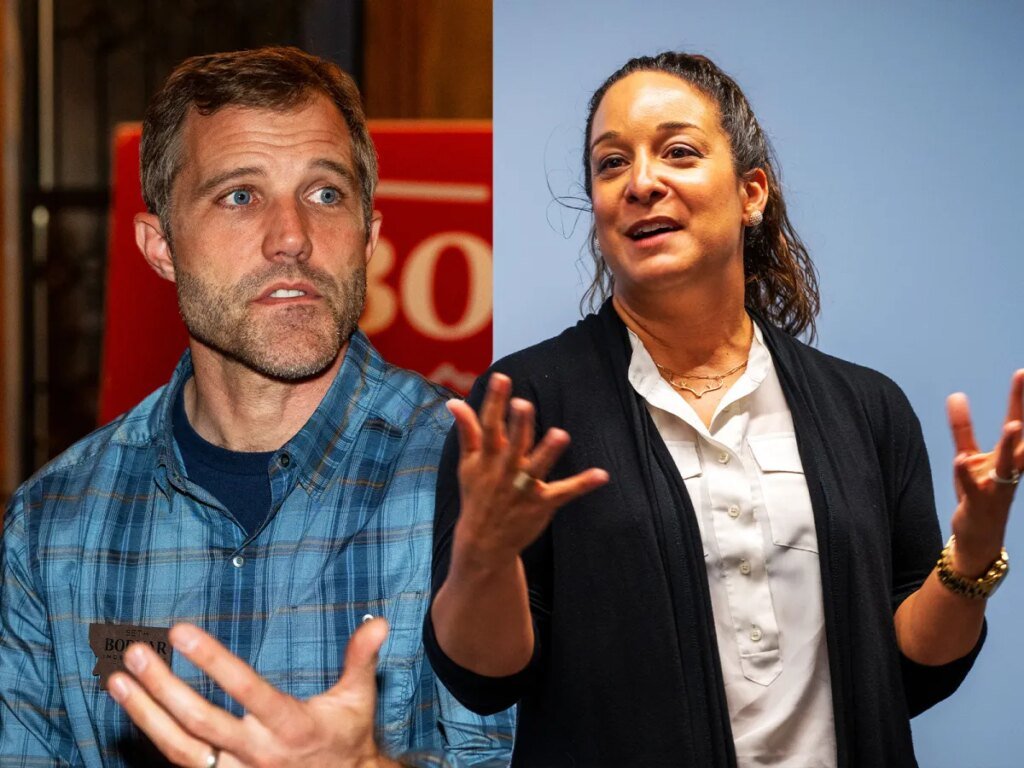
On March 4, Bodnar, a former Green Beret and president of the University of Montana, filed to run in the Senate race as an independent. It was a big decision: He’d consulted with politicians in the state about whether to run as an independent or a Democrat. In now infamous leaked text messages published in January, former Sen. Jon Tester (D-MT) — one of Bodnar’s backers — said that the Democratic Party had been “poison” to his past two campaigns and that a Democratic candidate could not win statewide. (These texts were still a fresh wound for some Montana Democrats TPM interviewed this month.)
Not everyone shared Tester’s view. Schweitzer, a Bankhead endorser, told TPM that Bodnar was getting a lot of advice to run as an independent; Schweitzer said a friend asked him to try to convince Bodnar to run as a Democrat.
“I had three conversations with him back in January,” Schweitzer said. “I said, ‘If I can’t convince you of simple math on the phone, buy a $1.37 calculator — and what that $1.37 calculator would tell you is that if a Democrat and Republican and independent run in Montana, you can’t win as an independent. It’s not gonna happen. It was tried before and it didn’t work, and it won’t work this time. I strongly encourage you to run as a Democrat.’”
But at that point — late 2025-early 2026 — there was a solid theory of the case for running as an independent in red terrain. Approval of the Democratic Party was in the toilet, and independent candidates like Dan Osborn in Nebraska had recently turned in promising overperformances. Sen. Bernie Sanders (I-VT) was even pitching the idea around.
“Lots of people said you had to run as part of a party, you can’t win as an independent,” Bodnar told TPM. “One thing I believed then and believe even more so now: You have to run and campaign absolutely true to who you are.”
Bodnar still maintains that he’s authentically an independent.
On that same day in March, hours after Bodnar filed, Daines upended the entire race. Minutes before the filing deadline, the Republican senator announced that he would not run again and endorsed Alme — who, coincidentally, filed his paperwork at the same moment.
“Who knows? Former Governor Bullock and others might have gotten into that race had they known it was not against a sitting incumbent with unlimited money,” Nancy Keenan, the former executive director of the Montana Democratic Party who endorsed Bodnar, told TPM. “Known Democrats, people who had run statewide, were shut out and the party was left with four people who had never run a statewide race.”
One of those people was Alani Bankhead, a retired Air Force lieutenant colonel and life coach who had never run for any office and is a relative newcomer to the state. (She moved to Helena in 2022.) At this time, she was little more than an “also running” in local coverage. She told TPM that she didn’t know that Bodnar would be running as an independent when she filed her candidacy in January.

Former one-term state Rep. Reilly Neil (D) pulled out in front of the primary pack. She made clear, publicly, that if she became the Democratic nominee, she would not drop out of the race to clear the way for Bodnar.
A hastily stood up entity called the Progressive Vet PAC started pouring millions into the sleepy primary to boost Bankhead. Signs point to the PAC being Bodnar-aligned: Its primary backer, Joseph Carroll of Hudson River trading, donated directly to Bodnar’s campaign after the primary. Its treasurer, former state Rep. Moffie Funk (D), hosted a fundraiser for him.
“I don’t think Alaini would have made it through the primary if it wasn’t for the PAC that swooped in to support her,” state Rep. Bob Carter (D), an eventual Bodnar supporter, told TPM in an email. “IMHO, they (the PAC) choose the weakest candidate to support in the primary, just to drop that candidate during the general election and actively campaign against her.”
After Bankhead won the primary, the PAC announced that a Democrat had no path to victory and pulled out of the race. Bankhead was also supported by the More Jobs, Less Government PAC, which had backed Republican Tim Sheehy in his 2024 race against Tester.
Bankhead Revisited
This is the point in the story where Bankhead became a main character.
“They spent $3 million to make sure Alani Bankhead won the primary and not Reilly Neil because somebody whispered that she’ll get out of the race,” Schweitzer said.
Bankhead said that national Democrats started circuitously, probingly, trying to convince her to drop out almost as soon as she’d won the primary. She said that she was cajoled by a sitting senator, governor and former Cabinet official, who asked her what job she’d want to do instead.
If Progressive Vet PAC or the Bodnar camp or the state party thought she’d be easier to force out than Neil, they were mistaken. (Her whole life coaching business is predicated on teaching people to overcome their self-doubt and imposter syndrome.)
Bodnar said that while “of course” he worried that having a Democrat in the race would make his math harder, he wasn’t expecting Bankhead to withdraw.
“We always planned for a four way race; we saw a libertarian in the race,” Bodnar said. “Would it have been easier if the Democrat had bowed out? Absolutely. It would have been easier if the Republican had bowed out.”
“I frankly never asked Alani Bankhead to drop out,” he added. “She asked me to drop out numerous times.”

Bodnar had the heavyweights — Tester, former Sen. Max Baucus (D), former Sen. Joe Manchin (D-WV), Pete Buttigieg — and the money. Bankhead had a shoe-string budget and the enthusiasm dampener of a perpetual news cycle about whether she was going to drop out of the race.
“I called Shannon who said the DNC would not be targeting the Montana Senate race, so yes — I could expect zero resources,” Bankhead told TPM, referring to former Montana Democratic Party chair Shannon O’Brien.
In July, state Democratic lawmakers sent a public letter, urging Bodnar and Bankhead to work things out among themselves. In August, they sent another, urging Bankhead to bow out.
“As the summer wore on, it became more clear to us that Bodnar had at least a fighting chance to win the Senate seat,” state Rep. Tom France (D), one of the signatories, told TPM.
Bankhead and Bodnar met multiple times, per both former candidates. Nothing changed.
It was then that Bankhead pushed Bodnar to exit the race.
“I said, ‘Look, we’ve built a strong campaign with buy-in — we got nearly 30,000 signatures to get onto this ballot,’” Bodnar said, recalling what he said to Bankhead in response. “We put in a fundraising mechanism and operation that was far stronger than anything that she had built.”
“We had built a really strong campaign and an operation with a real chance to win, and I thought we had the best shot,” he added. “I told her that if I thought otherwise, I would have dropped out.”
Bankhead said of the meetings that while Bodnar didn’t ask her to drop out in return, “he didn’t have to when Tester and his surrogates are bullying and harassing me on his behalf so he can have plausible deniability.”
As the situation grew more dire in October, O’Brien resigned as chair of the state party and endorsed Bodnar, seismic news in the state. “Bankhead does not have the momentum, resources or will to win this race,” she said in a statement.
“The whole pressure campaign was Tester and his whole machine calling people adjacent to me to get them to apply the pressure,” Bankhead said. “It was pretty funny to watch actually.”
Tester did not respond to an interview request.
A House Divided
The many Bodnar backers who spoke to TPM were all over the map on Bankhead. Some admired her tenacity, even if they felt it was wrongheaded. Some bristled at the idea of the outsider woman (and actual nominee) being pushed out for the outsider man — even if they agreed the latter had the better shot at winning. Some thought she was naive and selfish, running a vanity campaign and spoiling a rare opportunity. And some thought she was a Republican plant.
They all, to a one, thought that Bodnar was running a campaign that gave their coalition — if not their party in name — the best chance at Senate representation since Tester, who had hung on for three terms in the reddening state, was finally swept out in 2024.

Bankhead supporters, a much smaller group, were generally angrier about the Bodnar camp’s bungling of his run — whether by failing to clear the field, or convincing him to run as a Democrat — than they were high on her candidacy.
“It was horribly run and mismanaged from the beginning,” Bill Lombardi, a former journalist and staffer for Democrats including Tester and Baucus, said, adding: “It hurt Democrats up and down the ballot … It was a total and utter failure.”
“If we had a Democratic Party that was functioning this time, we would have gained a lot of seats in the House, maybe take back the House or Senate in Montana,” former Gov. Schweitzer added. “But we didn’t.”
Lombardi and Schweitzer felt strongly that Bodnar should have run as a Democrat, and the 2026 data gives them some ammunition for I told you sos. Liberal independents ran in Nebraska, South Dakota and Idaho. All three successfully cleared the official Democratic nominee out of the way. And all three lost.
“If you look in the rearview mirror and ask, ‘should Alani Bankhead have dropped out?’ Absolutely,” said Ben Super, executive director of Montana Conservation Voters and a Bodnar supporter. “Everyone has known that for months and months. Only now are people saying with certainty that Seth should have run as a Democrat. On November 2 and all points previous, it was maybe and now, yeah, he probably should have.”
In the end, Montana Democrats point to a lot of reasons why they’re dealing in disappointment and recriminations while some of their red state counterparts are basking in generational victories. And to some degree, they’re all correct. Bodnar shouldn’t have run as an independent unless he was sure he would have the left lane to himself. Tester et al. should have run an ally as the Democratic placeholder, or at least softened the ground to make it easier to push out the nominee. Bankhead should have dropped out when it became clear that, fairly or not, her campaign was sputtering and Bodnar’s had a real shot. Daines should have played fair and announced his intentions earlier, rather than treating the seat as personal property to be bestowed.
For now, they’ll have to content themselves with lesser wins: Sam Forstag, the smoke jumper — and Democrat — won a U.S. House seat in the super competitive 1st district representing the relatively bluer western side of the state. They bagged three progressive ballot initiatives, including one that would ban corporate spending in elections (if it can survive a Republican court challenge). Officially nonpartisan but actually Democrat Amy Eddy won a state Supreme Court seat, maintaining the bench’s 4-3 liberal majority. Democrats flipped two state House and two state Senate seats.
But it still stings.
“Old guard Democrats in Montana missed the wave,” Lombardi said.