
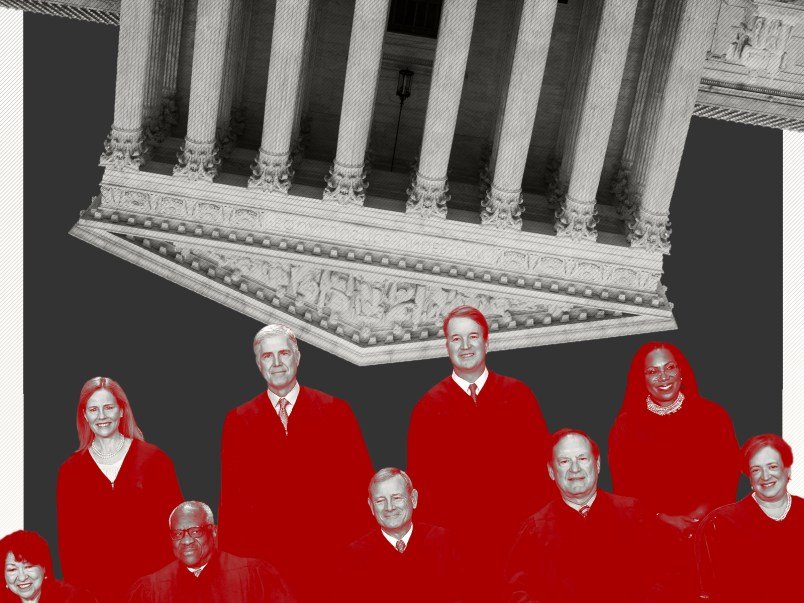
Choking on the blistering injustice of the Callais decision, even normie Democrats are starting to make noise about drastically remaking the Supreme Court.
Both former Vice President Kamala Harris and Sen. Ruben Gallego (D-AZ) have come out in support of court expansion in recent weeks, the reform that has come to shorthand a willingness to fundamentally change the institution. That two 2028 presidential hopefuls have come onside suggests a calculation that changing the Court will be a litmus test for the future nominee.
Even a Republican, retiring Rep. Darrell Issa (R-CA), made overtures to House Judiciary Ranking Member Jamie Raskin (D-MD) during a hearing on court reform Thursday, expressing interest in Raskin’s bill that would change how the Court chooses its cases and offering to collaborate on setting caps for gifts the justices can receive. This was not the tone of most Republicans at the hearing: Rep. Michael Baumgartner (R-WA) warned that court packing and its “evil twin,” adding states, “would be a recipe for potential civil war in this country.”
Reforms that would break the supermajority right-wing Court’s grip on the country — its operating as a legislative veto for Democratic administrations and a hall pass for Republican ones — would go far beyond docket management and ethics reforms, though. Term limits, court packing, jurisdiction stripping — the ideas lighting up the intellectual left and spreading to Democratic officials would overhaul the Court as we know it.
Implementing any of them would require a landslide Democratic victory in 2028 and a temperamental sea change from the lawmakers swept into power.
“Democrats let principles get in the way of winning and Republicans have generally not been concerned with that,” Justin Crowe, a professor of political science at Williams College, told TPM. “When will Democrats be ready to sacrifice principles to win, even if it’s sacrificing principles in the short term to win and reinstitute principles in the long term? Whether they can get there or not, I don’t know.”
Expand the Court
Pro-reform Democrats have gravitated towards court expansion recently because it’s unquestionably constitutional (Congress has done it many times before), and justices could be added immediately.
On Thursday, Raskin alluded to the popular idea that the Court should be expanded to 13, reflecting the number of Courts of Appeals.
“We can look at the question of whether every federal circuit should be represented on the Supreme Court,” he said.
The Court’s number would likely balloon with every White House and Senate party change — Republicans and their witnesses repeatedly invoked the image of justices filling a baseball stadium — though that’s a feature and not a bug to some proponents. It could both lessen the Court’s legitimacy and require a system of rotating judicial panels like circuit courts have, injecting some randomness into the ideological makeup of the justices ruling on each case.
And for all their hysterics over the concept, Republicans have done something similar before — quite recently, in fact. Then-Senate Majority Leader Mitch McConnell (R-KY) effectively decreased the Court’s number to eight for well over a year during the Obama administration when he blocked the confirmation of Merrick Garland, and raised it back to nine with President Donald Trump’s appointment of Neil Gorsuch.
State Republicans have indulged too: Utah, unhappy with its Supreme Court for dutifully enforcing a voter-approved partisan gerrymandering ban, packed on two conservative partisans to get redder maps through. The Republican legislatures in Arizona and Georgia similarly added two seats to their Supreme Courts in 2016 to lock in right-wing majorities.
Still, the reform is not without its downsides. Democrats would have to figure out a way to pass legislation to expand the Court while insulating the legislation itself from the current Court’s veto, despite its clear constitutionality. A possible answer could be embedding jurisdiction stripping into the law — a gambit Democratic members are trying in the No Kings Act, which seeks to bar the Supreme Court from hearing cases about a president’s criminal acts.
Court packing would also likely be seen as the most “nakedly political” of the reforms, Crowe said. Even FDR ensconced his court packing scheme in the anodyne sounding Judicial Procedures Reform Bill.
Term Limit the Court
A more broadly popular reform that Raskin endorsed Thursday is limiting the tenure of the justices. The Constitution mandates that “The Judges, both of the supreme and inferior Courts, shall hold their Offices during good Behaviour,” which has been taken to mean a lifetime appointment. To get around editing that directly (which would require an impossible-to-achieve constitutional amendment), some legal scholars, including those at the Brennan Center, have devised a workaround. The justices would serve 18 year terms, then take “senior status” and serve on lower courts. Add to this formula staggered appointments — one every two years — and each president would get the chance to nominate two justices.
Many of the reform’s fans, including Raskin, point to its sky-high approval numbers — though, in today’s media environment, that number may well crater if it became widely understood to be a Democratic-backed policy.
The TERM Act, one of the most popular bills that would enact this style of reform, would apply immediately to the current justices. Justice Clarence Thomas would take senior status first, followed by Justice Samuel Alito two years later, per Stephen Spaulding, managing director of the Kohlberg Center on the U.S. Supreme Court at the Brennan Center.
“A number of members joined and cosponsored the bill over the last couple weeks,” Spaulding said. “There’s real momentum.”
The same problem with a court packing bill crops up with this one: You’d need jurisdiction stripping or some other measure to guard the legislation from knee-jerk nullification by the Supreme Court.
Box Out the Court
Some scholars and activists want to take these reforms even further — end judicial supremacy, and shift the power to interpret the Constitution back to Congress, meant to be the most powerful branch. In a maximalist version, Congress would strip the jurisdiction of the Supreme Court to invalidate new federal laws; it could only enforce them. If the Court professed to strike down a new law, Congress and the president would ignore it.
This idea isn’t without precedent. President Abraham Lincoln, famously, refused to enforce the Dred Scott decision where slavery didn’t already exist. The Republican Party in 1860 rejected the ruling as partisan and nonbinding, saying that the Court lacked jurisdiction: “The new dogma that the Constitution, of its own force, carries slavery into any or all of the territories of the United States, is a dangerous political heresy…” read the official platform.
Citing Lincoln’s understanding that judicial supremacy is not constitutionally required, court reform group Court Accountability Action writes in a memo that the Roberts Court has effectively “rewritten the Constitution to dismantle the core pillars of 20th Century progress” and made future advances impossible.
“The result is a system of ‘autocratic legalism,’ where democracy dies not through military coups but through legal mechanisms that appear legitimate while systematically dismantling popular sovereignty,” it reads. “While litigation can limit the damage, it cannot reverse the tide.”
This reform would not require legislation that the Court could summarily knock down. It would require Democrats to embrace a very different system of governance than we have now, where the Court is weakened in favor of Congress.
“You all on the panel are members of Congress,” Harvard Law School professor Nikolas Bowie, one of the academics whose scholarship has undergirded this reform, said at Thursday’s hearing, addressing the assembled legislators. “You took an oath to support the Constitution and I trust your judgment that you can determine what counts as appropriate legislation for enforcing the Constitution. If you think the Voting Rights Act needs to be updated for our modern time, you can amend the Voting Rights Act, you can make it better.”
“We did not elect a Supreme Court to do that job for you,” he added. “We did not vote for justices to override your interpretation of what the Constitution means. It disrespects your oaths if the Court takes your words that you have taken the responsibility to enact into legislation and says ‘actually, you’re wrong.’”