
Sky York Journal
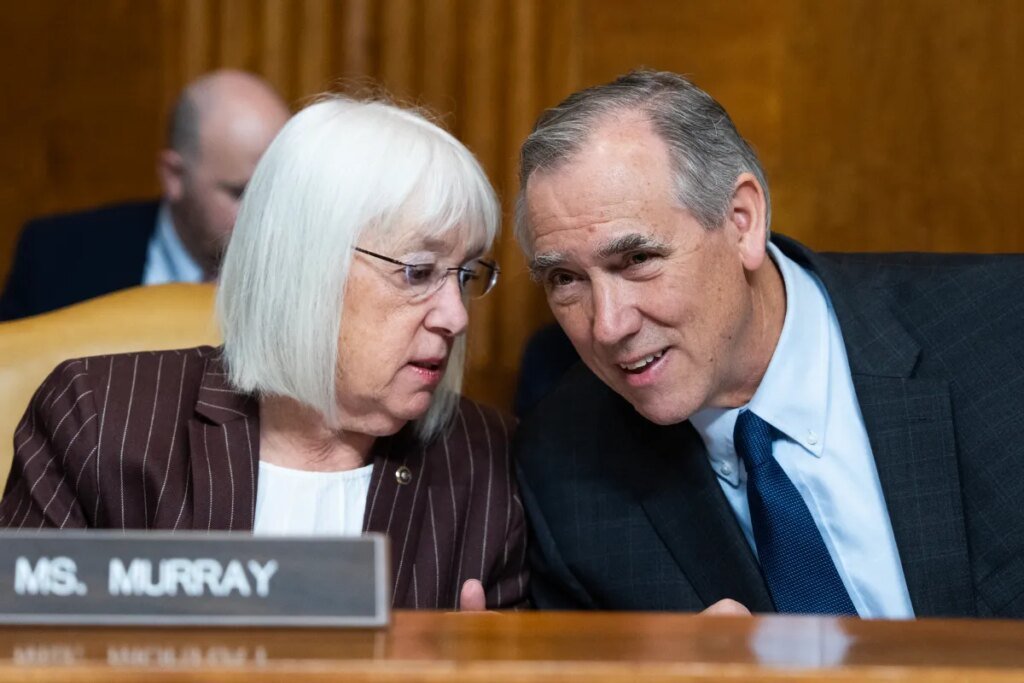
Senate Appropriations Committee Ranking Member Patty Murray (D-WA) and Senate Budget Committee Ranking Member Jeff Merkley’s (D-OR) attempt to pass a bill blocking the $810 million “pocket rescission” the Trump White House sent over to Congress last week failed Wednesday evening.
Sen. Ron Johnson (R-WI) objected to Democrats’ request seeking unanimous consent on the Senate floor on their bill to nullify President Donald Trump’s most recent illegal pocket rescissions. Since Murray and Merkley were seeking unanimous consent — a procedural move to fast track a bill and bypass roll call votes — one Republican objection was enough to derail the effort.
Johnson said he was “happy” to reject the unanimous consent request from Democrats, claiming both that the Impoundment Control Act is poorly written and that the pocket rescission request from the White House was not big enough, as he gave a lengthy speech about the national deficit.
“I personally am glad, I don’t care who the president is or what party, I will generally support that president reducing spending. And I’d applaud it,” he said from the Senate floor objecting to Democrats’ request. “So I’m happy to allow the president to do pocket rescissions, other types of rescissions — whatever it takes because Congress is certainly not fiscally responsible.”
The proposed bill would have also prevented the president from attempting to use a pocket rescission in the future by forbidding any president from submitting rescissions requests under the Impoundment Control Act of 1964 within 90 days of when the funds expire.
Pocket rescissions describes a loophole Office of Management and Budget (OMB) Director Russell Vought and his allies believe they have found in the budgeting process that, they claim, allows them to declare congressionally approved funding rescinded if a rescissions package is sent to Congress close to the end of the fiscal year when funds will expire.
A formal rescissions request starts a 45-day clock in which the executive branch is allowed to withhold the cash in question while it awaits Congress’ permission to not to spend it. But if the request comes in 45 days before the new fiscal year is set to begin, Vought contends, the White House could withhold the money for that timeframe, regardless of whether Congress takes action on the package, and then claim that the funding is expired with the end of the fiscal year.
Murray and Merkley’s proposed bill would see Congress act on the request, sidelining the White House scheme to simply run out the clock by sending a rescission request at the last minute.
The Government Accountability Office, a nonpartisan legislative branch agency tasked with deciding if the president is impounding funds in violation of the ICA, has previously declared that pocket rescissions violate the law.
On Tuesday, in a letter to congressional leaders, the GAO reasserted that position and declared the most recent pocket rescission attempt as illegal.
“The rescission proposals contained in the President’s September 25, 2026, special message to Congress do not permit the President to withhold the appropriations beyond the end of fiscal year 2026,” the GAO said.
In a Friday statement, Senate Appropriations Committee Chair Susan Collins (R-ME) said the move is “the most recent attempt by this Office of Management and Budget (OMB) to undermine Congress’s Constitutional power of the purse.”
“This move shows that OMB intentionally withheld these funds for months to execute this unlawful cancellation of appropriations that were approved on a bipartisan basis and signed into law,” Collins said.