
Congressional Democrats who have been in classified briefings have been denouncing the lack of detail they have received from the Trump administration regarding military actions against Iran. They have specifically pointed to what Democrats describe as a lack of evidence that Iran posed an imminent threat to the continental U.S. that would necessitate military action.
The so-called Gang of Eight — which includes House Speaker Mike Johnon (R-LA), Senate Majority Leader John Thune (R-SD), Senate Minority Leader Chuck Schumer (D-NY), Senate Select Committee on Intelligence Chair Tom Cotton (R-AR) and ranking member Mark Warner (D-VA), House Minority Leader Hakeem Jeffries (D-NY), House Permanent Select Committee on Intelligence Chair Rick Crawford (R-AR) and ranking member Jim Himes (D-CT) — was briefed on Monday about the U.S. strikes on Iran. Separately, bipartisan staffs of “several national security committees in both chambers” were briefed on the issue on Sunday.
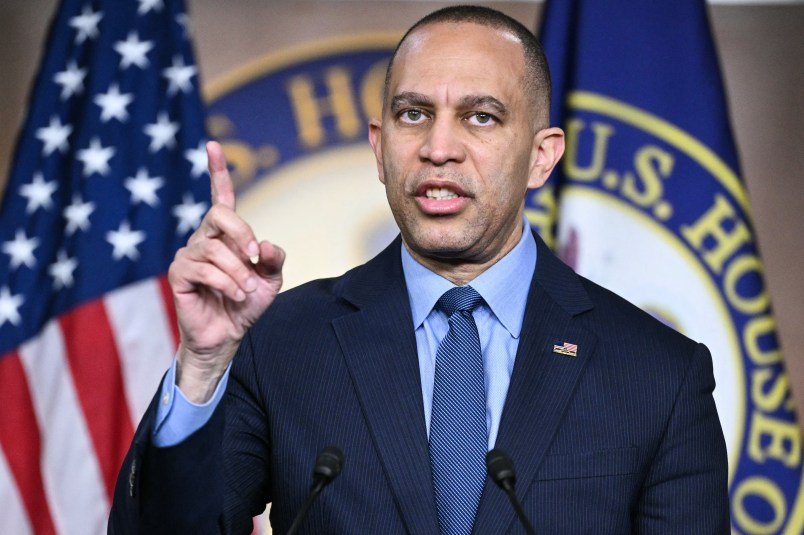
“Having been briefed now, not once, but twice, there is no evidence that has been presented to us that the United States was under threat of imminent attack from Iran,” Jeffries told reporters gathered for his Tuesday press conference. “Zero evidence of that. In fact, many members of the administration have actually publicly now admitted that.”
“So if, in fact, that was the case, it’s hard for the American people to understand the rationale from launching a preemptive war in the Middle East that has now spread to more than half a dozen countries and resulted in the death of at least six brave, courageous, heroic service members,” Jeffries continued. “That’s unacceptable.”
Warner also made a point to publicly stress the same issue following the Gang of Eight briefing.
“There was no imminent threat to the United States of America by the Iranians,” Warner told reporters on Monday.
“I believe at the end of the day, when we are talking about putting American soldiers in harm’s way, when we have American casualties and expectations of more, there needs to be the proof of an imminent threat to American interest.” Warner added.
On Tuesday, Schumer would not get into specifics when questioned about the Monday briefing, saying he “can’t talk about a classified briefing.”
“I can tell you I left that briefing with more questions than I went in with,” Schumer said. “It was not a very satisfying briefing.”
The Democrats’ comments come after President Donald Trump posted a video early Saturday morning announcing the U.S.’s military actions in Iran, saying that his objective in launching the attack was “to defend the American people by eliminating imminent threats from the Iranian regime.”
Trump doubled down on that rationale on Tuesday, telling reporters gathered in the Oval Office: “If we didn’t do it, they were going to attack first.”
That is different than what Secretary of State Marco Rubio told reporters on Monday when he said, “we knew that there was going to be an Israeli action, we knew that that would precipitate an attack against American forces, and we knew that if we didn’t preemptively go after them before they launched those attacks, we would suffer higher casualties.” The Trump administration and Rubio himself have since tried to walk that back.
The full Senate and House are set to receive separate briefings Tuesday afternoon from Rubio, Defense Secretary Pete Hegseth, Chair of the Joint Chiefs of Staff Gen. Dan Caine and CIA Director John Ratcliffe.
Both chambers are also expected to separately vote on war powers resolutions this week. The Senate will vote on Sens. Tim Kaine (D-VA) and Rand Paul’s (R-KY) measure to rebuke Trump over his attack on Iran without congressional authorization on Wednesday and the House will vote on a resolution from Reps. Thomas Massie (R-KY) and Ro Khanna (D-CA) on Thursday.
Jeffries told reporters on Tuesday that Democrats will “work to make sure that the war powers resolution, which is bipartisan in nature, passes on the House floor” this week, calling the effort “a matter of the utmost significance.”
The resolutions are expected to fail.
Jeffries pressed that the framers understood that this is possibly one of the most important decisions Congress can make.
“They decided they don’t want a king like figure being able to unilaterally decide to send American men and women to war,” Jeffries said. “That’s why, in Article One of the Constitution, this power was explicitly given to the Congress, and it’s now the Congress’ responsibility to go on record, because Donald Trump has unconstitutionally and illegally chosen to launch a war.”